
I’ve been researching mystery stories set on Canadian campuses, and that’s directed me to writers I’ve intended to read for years, including the prolific Eric Wright (1929-2015). Wright authored four crime fiction series, and his achievement is especially impressive given his relatively late start as a novelist. The first decades of his career were taken up with work as a professor, department chair, and dean at what was then known as Ryerson University (today’s Toronto Metropolitan University). His vivid depictions of campus life have led reviewers to suggest that he was drawing extensively on his own experiences.
Campus fiction, or the academic novel, or the university novel, has a lengthy history in the U.S. and the UK. And a rather briefer one in Canada, at least as far as I’ve been able to determine to date. There are a few intriguing exceptions. Frances Shelley Wees, born in 1902, published more than twenty thrillers and suspense novels over her career. While born in the U.S., she spent her entire adult life in Canada. I’ve just started delving into her fiction: The Mystery of the Creeping Man, published in 1931, has a campus setting but not a Canadian one; her best-known book, The Maestro Murders, has a professor as the victim.
Robertson Davies’s The Rebel Angels (1981) is often cited as an influential Canadian campus novel. In recent years, it’s been joined by a diverse array of works focusing on faculty members, administrators and/or students. Some of the most notable examples include Suzette Mayr’s Dr. Edith Vane and the Hares of Crawley Hall, Randy Boyagoda’s Original Prin, Maureen Medved’s Black Star, Sarah Henstra’s The Red Word, and Mona Awad’s Bunny. Although the latter and its sequel, We Love You, Bunny, are set in New England.
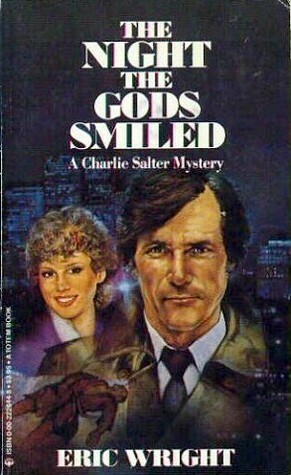
Wright is an interesting figure to look back to in this context. He wrote about the world of academia in a knowing, amusing, sometimes cynical manner, and many of his themes are echoed in current campus fiction. He also delved deeply into public perceptions and misconceptions of higher education, and he explored class and economic issues within the system, with acute insight. His Toronto-set police procedural series featuring Inspector Charlie Salter opens with The Night the Gods Smiled (1983), which won the Arthur Ellis Award for Best Crime Novel.
The protagonist’s approach to sexuality will strike modern readers as at best quaint, with some truly cringe-inducing moments. But these are crisply written books that explore Salter’s midlife ennui, after a career misstep that leaves him consigned to tedious investigative assignments. At the request of the police in Quebec–who reportedly have their hands full with post-referendum separatist malcontents–Salter takes on the task of interviewing the friends and colleagues of a local English professor, found murdered at a Montreal hotel.
The victim taught at a 1960s-era downtown college off Yonge Street, and Wright has fun describing the peculiarities of the architecture. The murder took place during an annual conference, one that sounds a lot like the Congress of the Social Sciences and Humanities. The potential culprits include aggrieved department rivals and romantic partners. Conference affairs are omnipresent here, leading Salter to remark that “these conferences of yours sound like giant games of musical beds” (171).
Wright’s fourth and final series follows Joe Barley, a part-time instructor at the satellite campus of a Toronto university. The series opens with The Kidnapping of Rosie Dawn (2000), which was nominated for an Edgar Award. Joe supplements his income by working for a small private investigation agency, and he is drawn into the disappearance of a student, who’s putting herself through school by working as an exotic dancer.
A sub-plot involves Joe’s support for his embittered office mate Richard, who rails against academia’s two-tier faculty employment system. Richard is faced with the potential loss of his position, after he’s accused by a student of racial bias, and Joe helps him find the perfect lawyer to defend him. Unlike Richard, Joe is pretty happy in his unionized sessional position. He dislikes scholarly research and left his doctoral program ABD, so the opportunity to do the teaching he loves without having to churn out academic articles satisfies him.
The author has interesting observations about academic employment and working conditions, and a quarter century later, not much has changed in this realm. Wright was a significant figure throughout the two decades of his mystery-writing career, and his achievements were attested to by his peers at the time of his death in 2015. There’s relatively little published work on Canadian crime fiction, so my research has been heavily rooted in reviews, interviews, and posthumous tributes.
Peter Robinson, writing in Quill & Quire, has a warmly affectionate piece about Wright. Robinson describes how “Eric had a way of sharing confidences, imparting gossip, telling stories, and whispering asides that made them feel secret, revelatory, dangerous even, as if there were a subtext I couldn’t quite grasp, though there was nothing in the actual content of our conversations to merit this. I can only put it down to his working in the academic world for so long.”
 The Landscape of Canadian Women's Crime Fiction
Leave a comment