Dorothy L. Sayers was a prolific writer of Golden Age mystery fiction, co-authoring several works with Detection Club members, as well as producing her own long-running Lord Peter Wimsey (and Harriet Vane!) series. But her writing achievements as a whole were much broader.
Sayers had a classical education, and a lot of Latin shows up in the Wimsey novels. Re-reading Busman’s Honeymoon, in my present mood, has been a bit much. The quoting is fast and thick and the delight in learning, which I normally enjoy in Sayers’s brainy books, overwhelms the plot. Harriet and Peter are newly married, and they are thrilled to have both intellectual and sexual passion.
Starting in the middle of the 1930s, Sayers’s work increasingly had a religious focus. Except for a handful of Wimsey stories, she stopped writing detective fiction by the beginning of the Second World War, and CBC produced her play The Zeal of Thy House as a radio drama in 1948. Sayers drew on the life of the architect of Canterbury Cathedral, and the rebuilding of the cathedral after a fire in the 1100s. In fact, her work was originally presented there.
This radio adaptation is rich with plummy accents. There’s much declaiming, and some musical interludes that are heavy on trumpets. I tried very hard to listen all the way through, but I don’t have the capacity for close listening that earlier generations must have possessed. Or the fervent faith. Both the spirit and the flesh were weak, in my case.
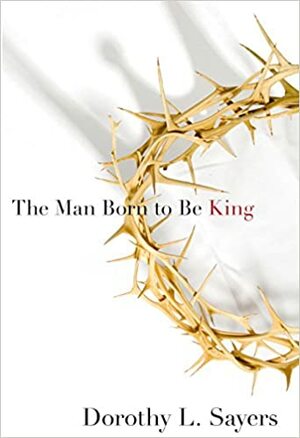
Yesterday, in a second-hand bookstore, I happened across another of Sayers’s Christian works. A first edition of The Man Born to Be King, which is perfect timing for the Easter season. The book is a set of twelve short plays, composed as a BBC commission for the edification of children in its audience.
It’s surprisingly readable, and studded with humour and insight. Sayers’s Mary, Christ’s mother, is a particularly poignant and subtle portrayal. She seeks to inch closer to her dying son, and is repeatedly discouraged and rebuffed. All she wants is to offer any comfort in her power. She has known for three decades what her son’s fate will be, and she faces it with tragic fortitude.
Sayers came from a clerical tradition, as her father was chaplain at Oxford’s Christ Church College, and then became rector at a nearby East Anglian parish. He began her Latin lessons when she was young, and she later added several other languages to her repertoire. Including enough ancient Greek that she could do her own translations from Greek scriptures, rather than relying on the King James Bible. The choices she made in crafting the twelve radio plays, which apparently suited the BBC nicely, included the use of colloquial language and slang.
As a piece about Sayers for the C.S. Lewis Institute website notes, Sayers had deep and fervent High Anglican faith. She believed writing could be a conduit for interpreting church doctrine, but that the King James language would not have the appropriate appeal.
“Overuse of ecclesiastical language, stale curates, and excessive talk of Christ being meek and mild had made the Lion of Judah boring. She was blunt on this point. ‘Nobody cares . . . nowadays that Christ was ‘scourged, railed upon, buffeted, mocked and crucified’ because all those words have grown hypnotic with ecclesiastical use.’ But if one wrote that Christ was ‘spiked upon the gallows like an owl on a barn-door,’ this would not only get people’s attention, it would recall what actually happened to Him.”
The first segment was to be broadcast on BBC radio in 1941, a few days before Christmas, with the remaining eleven at intervals of four weeks. The second broadcast was to be compressed between the beginning of Lent and Easter, the following year.
But before the first play could air, there was public protest. It looked like the project might not be heard at all, because the BBC was deluged with letters. At that time, Jesus Christ couldn’t be played on a theatre stage, so having him portrayed by an actor in a radio drama was viewed by some as sacrilegious. Others objected to overt Christian content on the public broadcast.
These criticisms were being levelled at Sayers when none of those who were remonstrating had, as yet, had an opportunity to read or listen to the work and evaluate it on its own merits. I’m reminded that a close friend has faced appalling threats and condemnation because of her adorable children’s picture book, Pride Puppy. A work that most critics seem not to have read, given that it’s been characterized in bizarre and inaccurate ways.
The U.S. Supreme Court justices will be reading Pride Puppy alongside several other books, to assess a “parents’ rights” case against a school district that “refused to allow parents to opt out their children from language-arts instruction involving the books over religious beliefs.” But I suspect that if the parents involved–and the cynical organizations manipulating individual parents, as part of a broader agenda–actually read the book, they would find little to dislike in this sweet tale of a puppy who gets lost in the colourful crowd at a Pride parade.
Similarly, the condemnation of Sayers’s project largely died down once the radio series began broadcasting. Although she’s introduced some intriguing elements and is a careful scholar of language, this is a pretty orthodox rendering of the Gospels.
My stepfather referred to God as “she” during his 1980s United Church sermons. He admired Sayers, and he agreed that it was important to keep updating the language we use to talk about Christianity. He saw the church as a means for human compassion and empathy, rather than faith as an end in itself. We’ve missed him since 1992, but the loss feels oddly fresh this year, because I’ve been re-reading a few of his sermons.
I’m not a believer, but the music of Easter is extraordinary. I’ll be listening to it as I bake and cook for a couple of days, with breaks for gardening, if the sun comes out. My weekend reading will be Eliot’s Four Quartets.
From “East Coker”:
The dripping blood our only drink,
The bloody flesh our only food:
In spite of which we like to think
That we are sound, substantial flesh and blood—
Again, in spite of that, we call this Friday good.
And my Easter playlist:
Pergolesis’ Stabat Mater
Bach’s Easter Oratorio and St John Passion
Tallis’s Lamentations of Jeremiah
Handel’s Messiah
Haydn’s The Seven Last Words . . . and these lovely poems by Mark Strand sometimes accompany the performance of the piece; a friend introduced me to them, when he was asked to participate in a Good Friday chamber concert
Finally, Missy Mazzoli’s Dark with Excessive Bright, which I gleaned from other Easter playlists. Her music is glorious and her composer note is evocative.
“While composing Dark with Excessive Bright for contra bass soloist Maxime Bibeau and the Australian Chamber Orchestra, I continuously listened to music from the Baroque and Renaissance eras. I was inspired in no small part by Maxime’s double bass, a massive instrument built in 1580 that was stored in an Italian monastery for hundreds of years and even patched with pages from the Good Friday liturgy. I imagined this instrument as a historian, an object that collected the music of the passing centuries in the twists of its neck and the fibres of its wood, finally emerging into the light at age 400 and singing it all into the world. While loosely based in Baroque idioms, this piece slips between string techniques from several centuries, all while twisting a pattern of repeated chords beyond recognition. ‘Dark with excessive bright,’ a phrase from Milton’s Paradise Lost, is a surreal and evocative description of God, written by a blind man. I love the impossibility of this phrase, and felt it was a strangely accurate way to describe the dark but heartrending sound of the double bass itself.”
 The Landscape of Canadian Women's Crime Fiction
Leave a comment