
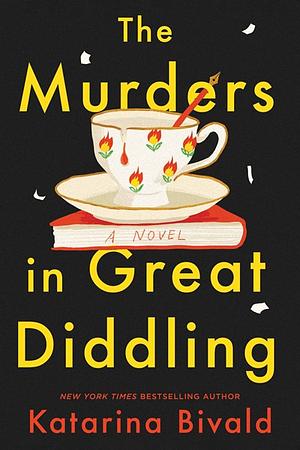
The Edgar nominations were announced last month, and Katarina Bivald’s The Murders in Great Diddling is up for the Lilian Jackson Braun Award for best new cozy mystery. In the cozy, as the name suggests, the violence is off-stage and not off-putting. The victim may be widely disliked as in Bivald’s book, or the crime may be virtually bloodless. Louise Penny incorporates aspects of the cozy into her work, with the chummy scenes of croissants at the bistro, but she also dabbles in the genres of thriller and police procedural.
Bivald is doing something quite different, taking up the conventions of the cozy in order to re-invent and parody them simultaneously. Her fictional small town, Great Diddling, is only superficially a place of refuge. A Cornish would-be tourist haunt, it’s not on the coast or particularly charming, and that’s a problem when it comes to luring in fee-paying guests. The Great Diddlers have made do with a series of ersatz historical plaques, claiming significant personages made their appearance at various moments. Churchill after Dunkirk, for one. But it’s all invented tradition.
The aristocrat in the big house, Daphne, has an entailed estate and a crumbling heap filled with books. She’s a bibliophile, but Bivald is attentive to the darker side of caring more about stories than people. Daphne reluctantly hosts a tea for the townspeople, but she’d really rather be curled up with a novel. Her adult nephew, who arrived unexpectedly for a visit, is keen for his inheritance (the land, not the books). When he’s blown up in the home’s second library during the tea, with dozens of villagers on-site to witness the explosion, there’s a crime to solve . . . and exploit.
Swedish-British novelist Berit moved to a charming, wisteria-strewn cottage in Great Diddling on a whim, and she has writer’s block. Her agent has dispatched her own daughter to cajole Berit into productivity, but Berit prefers not. The prospect of a murder investigation, on the other hand, intrigues her. She even begins offering guidance to the police as she gleans intelligence from her neighbours.
Some of the locals have been around for generations, but the newer arrivals are a motley and mysterious crew. The sweet elderly sisters running the bakeshop have a much more interesting history than anyone has guessed. The hotel owners, one of whom threatened to kill the victim shortly before his death, are drowning in bills. Suspects pile up because the victim intended to revoke leases with half the business owners in town, in aid of his own mysterious vision for Great Diddling.
Meanwhile, local mover-and-shaker Sima seems oddly situated in the town; she decides they have the perfect opportunity for a Crime and Books festival. With two weeks’ notice, no famous authors are available. Not a problem. Sima will recruit volunteers and a credible Margaret Atwood will be produced, with make-up and an assumed Canadian accent, smoothly quoting herself and smiling slightly at the intellectual inferiority of her audience.
This is a lot of fun, and it’s a book-lover’s dream book. The descriptions of Daphne’s ill-maintained library are envy-inducing, with her collection of Golden Age detective novels, inscribed by the authors for their fellow mystery writers. And it’s a knowing look at the Midsomer Murders: Great Diddling is hoping to be the next big thing and attract crime-fiction tourism. Why shouldn’t every small English town have its turn at notoriety?, they wonder.
That being said, it’s a long novel and while each episode is diverting, there’s a certain amount of repetition. Bivald writes crackling and funny prose and the dialogue is spot-on, but readers may tire of the conceit before the plot is resolved. For me, what Bivald brings to the cozy–including racial diversity and lesbian and bisexual characters, who are often thin on the ground in this genre–is more than worth the effort.
 The Landscape of Canadian Women's Crime Fiction
Leave a comment