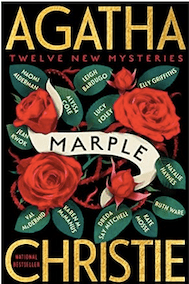
Lucy Foley, the British crime writer, recently announced that she has been selected to write new Miss Marple novels. The first in a planned series will be out in Fall 2026, to coincide with the 50th anniversary of Sleeping Murder, the final Agatha Christie Marple novel.
As it happens, I’m finishing up the BBC adaptation of Sleeping Murder with Joan Hickson in between dealing with various legal documents, and this juxtaposition makes the protagonist’s peremptory purchase of what turns out to be her childhood home rather peculiar to me.
There is a lot of disclosure and paperwork involved in all real estate transactions, even rentals.
It boggles the mind that Gwenda has arranged such a quick move into the house she spots while driving around the countryside. She’s just arrived from New Zealand, where she’s grown up, and is in search of a home for herself and her new husband. He hasn’t yet arrived in England but will follow in a few months. (In the adaptation, they’re undertaking the driving tour together, but the initiative is still all Gwenda’s.)
Here’s Christie:
“Gwenda made her way to the post office and dispatched a cable to Giles.
Have bought a house. Love, Gwenda.
‘That’ll tickle him up,’ said Gwenda to herself. ‘Show him that the grass doesn’t grow under my feet!’”
I could use Gwenda by my side as I pore over small print about latent defects, roof trusses, and rodent inspections.
In undertaking to compose new Marple novels, Foley is joining Sophie Hannah, author of the recent Hercule Poirot adventures. I tried two of these and found them unsatisfactory. The plots are fine, but the prose style isn’t quite right, somehow. That is, Hannah hasn’t miraculously channeled Agatha Christie, which is surely an unfair expectation on my part.
I’m going to give Closed Casket a try before I give up on these.
But I do wonder if it’s a fundamentally doomed enterprise: why add to the corpus of great crime fiction with one’s own necessarily secondary contribution?
Anthony Horowitz is perhaps the most famous example of the trend: he was endorsed by Arthur Conan Doyle’s estate to write new Sherlock novels and produced The House of Silk, which I read and enjoyed a decade ago, and Moriarty, which I haven’t yet read. He joined the legion of less official Sherlockians who have written their own fan-fic takes.
For me, the best modern Sherlock is the contemporary BBC occasional series created by Steven Moffat of Doctor Who fame. I’d have liked even more of these, although the plots do become rather byzantine. The acting is superlative, and the series introduced me to Andrew Scott, who’s a wonder as Sherlock’s arch-nemesis.
But in written form, I’ve been less thrilled with series continuations, with the possible exception of Jill Paton Walsh’s excellent revision of Dorothy L. Sayers’s Peter Wimsey novels.
So I’m not holding out much hope for Foley’s Marple, in part because I’ve found her work uneven: I loved The Hunting Party and The Guest List and found The Paris Apartment and the recent The Midnight Feast weak in plotting and character development.
Conversely, the omnibus of new Marple stories by a range of authors was a lot of fun. Foley has a story in the collection which, in retrospect, was perhaps an audition opportunity for authors keen to write new Marple novels.
It makes sense that they didn’t select one of the American writers from this collection, but it would have been interesting to see what Dreda Say Mitchell, for instance, could have done with the opportunity to create new Marple books. Given the entrenched racism in Christie’s fiction, having contemporary contributions to the series by a Black woman writer would have been especially welcome.
I hadn’t realized that Margery Allingham’s Campion series has also had a second-life, with twelve additional works composed by Mike Ripley.
And Ace Atkins has kept Robert B. Parker’s Spenser for hire alive. I’ve only just realized (this is not at all my preferred crime sub-genre) that the Spenser for Hire series I watched as a teenager was an adaptation of Parker’s novels.
And in cozies, a writer I really like, Nancy Pickard, took over the culinary crime series created by Virginia Rich.
Perhaps most famously (and most lucratively), after Stieg Larsson’s death at age 50, David Lagercrantz wrote three more Lisbeth Salander novels, and then yet another author, Karin Smirnoff, took over.
Both continuation authors are Swedish, like Larsson, but the plot thickens, at this point, because Larsson’s partner of three decades, Eva Gabrielsson, opposed the new efforts.
He died intestate, and under Swedish law, his closest family members inherited.
She doesn’t have copyright in Larsson’s books, thus, but she does have in her possession the computer manuscript of another Millennium novel draft by Larsson and possibly some additional materials. And she’s not sharing: “She maintains that until all of the rights to her former lover’s works are handed over, God’s Revenge will never see the light of day — and Mikael Blomkvist and Lisbeth Salander will forever remain in literary limbo.”
God’s Revenge, indeed.
What are the odds that popular series will, in the near future, be continued by AI rather than by authors hand-selected by the estate?
 The Landscape of Canadian Women's Crime Fiction
Leave a comment