
Shouldn’t erotic thrillers have a murder? Or at least an accidental death that needs to be covered up? It doesn’t need to be investigated (as in Basic Instinct), but surely the stakes need to be high?
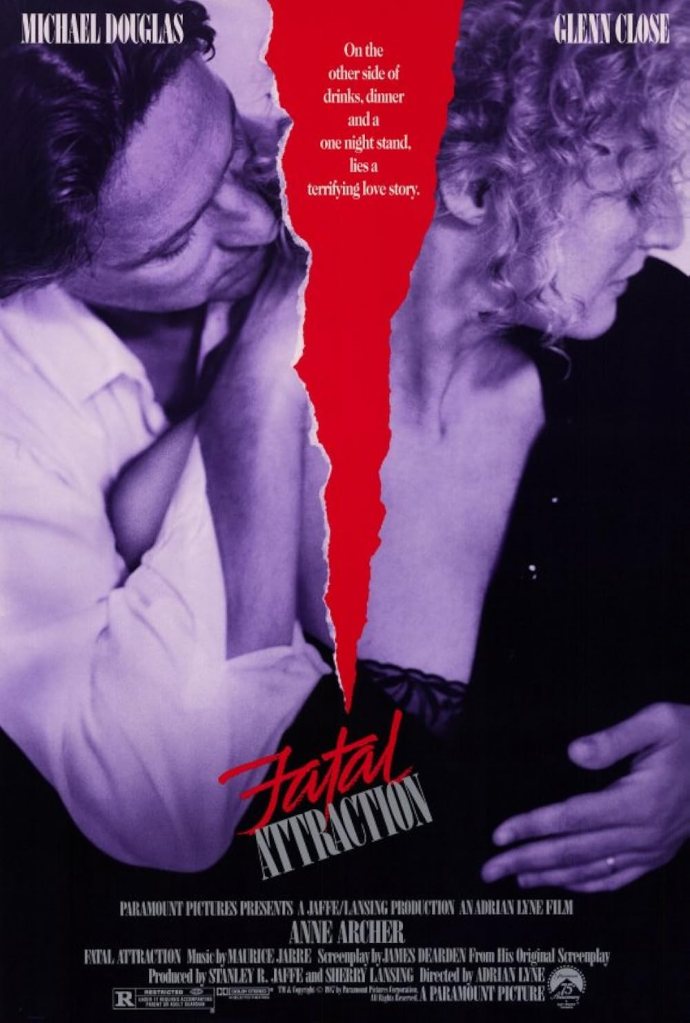
I’m thinking of Fatal Attraction, which spawned a thousand jokes about boiling bunnies.
It’s straight-forward misogyny, but it’s an interesting film.
Glenn Close plays the neurotically needy Alex. A weekend with a straying married man (Michael Douglas, who did a lot of these in the 80s and 90s) makes her come unglued. After one night, the threat of his departure prompts suicidal threats. Then she stalks him and his family (including the under-appreciated Anne Archer as his more-steely-than-she-looks wife).
They had to change the film’s ending to make it palatable to audiences: viewers wanted to see Alex murdered, not ultimately suicidal. Each iteration of editing made Michael Douglas’s character more likeable, and Glenn Close’s Alex more unhinged and evil.
But when the author adapted the film for the stage, he restored his preferred ending: “I can reveal that they will not be scraping Alex off the bathroom tiles, because Alex is emphatically not a monster. She is a sad, tragic, lonely woman, holding down a tough job in an unforgiving city.”
He goes on to defend (sort of) the glee with which audiences received the revised film ending:
“I am often asked if I regret the movie, or at least how it portrayed single career women. Yes, I regret that some people may have been offended. Do I regret the fact that audiences shouted ‘Kill the bitch!’ at the screen? Of course. But I think it tells you more about the audience than the movie. Did Fatal Attraction really set back feminism and career women? I honestly don’t believe so. I think that, arguably, it encouraged a vigorous debate from which feminism emerged, if anything, far stronger. And are there not more women succeeding in high-powered careers today?”
Is he taking credit for women advancing in their professions?
According to recent films, however, women may by “succeeding” but they are not necessarily fulfilled.
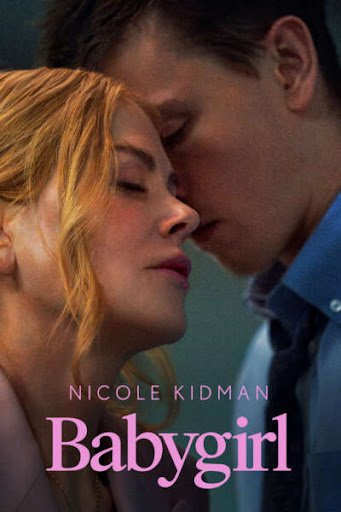
I’m a bit baffled by Babygirl, with Nicole Kidman and Harris Dickinson, which I’d expected to like. Her performance is terrific, of course. It’s just that the premise–a powerful woman who really only wants to be humiliated and controlled–is rather worrying. Its female director, Halina Reijin, describes it as a film about women’s sexual desires, but I kept thinking that it’s actually about having a very selfish boss.
Not because she embarks on an affair with a much-too-young yet fully self-possessed intern (Dickinson) while she’s married and raising kids. There’s a power differential here, but it’s not a straightforward one: for all of her success, Kidman’s Romy is also still beset by the expectations of traditional gender roles that have her scribbling sweet notes to pack with her kids’ lunches or faking orgasms with her husband. Even more than Allison Pearson’s heroine in I Don’t Know How She Does It, Romy seems to have to control every aspect of her complicated and jam-packed life.
And she makes all of it work.
But her assistant, Esme (the fabulous Sophie Wilde) is chafing. A promised promotion hasn’t materialized; even a promised conversation about the promotion has been repeatedly deferred.
One theory of the film is that Esme deliberately manipulates Romy into her entanglement with the intern, so that she can get what she wants, and that’s rather tantalizing.
It was nice to hear some familiar 80s tunes: George Michael’s “Father FIgure” and INXS’s “Never Tear Us Apart” (Michael Hutchence has been dead for nearly three decades, and his voice still undoes me.) Kidman wears many lovely frocks and several high-necked blouses with pussy bows. There’s a glossy apartment and a fancy house with a pool.
But it all feels very surface level, somehow.
At one point, late in the film, confessing to her husband (Antonio Banderas), Kidman’s character begins to cite her childhood as part of the reason for her own complicated sexual fantasies, and he cuts her off, telling her it’s not an excuse. But because we get virtually no back story, no explanation of what drives her, this is an unsettling but not especially interesting portrait of female ambition and mild masochism.
The assistant, in the Anne Hathaway role from The Devil Wears Prada, is more intriguing. At the end of the film, she owns the screen: she is now in charge of a program to foster women’s talent in the company, and she has achieved this by blackmailing her boss.
But it’s for the boss’s own good, really: her assistant just wants her to be a better role model for younger women, and not pull the ladder up after herself.
So for me, this was neither erotic nor a thriller, and the stakes weren’t high enough.
Perhaps what’s shifted, from Fatal Attraction to Babygirl, is that it would no longer be possible (I hope) to portray mental illness in quite so unforgiving a manner. Alex demonstrates textbook Borderline Personality Disorder. She’s not just a “crazy bitch,” in today’s more informed therapy-speak world. She’s a very ill woman who needs treatment.
 The Landscape of Canadian Women's Crime Fiction
Leave a comment