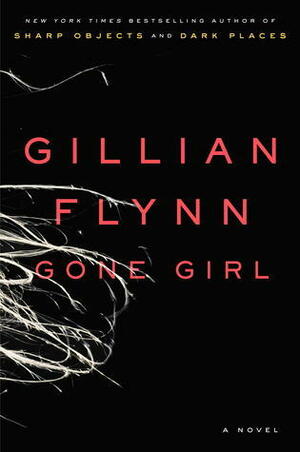
Gillian Flynn has been keeping busy with various projects, but there’s little news about her recent creative output. Perhaps it’s difficult to embark on a new book when you’ve had a novel go supernova, like Gone Girl did in 2012?
A bestseller adapted to film. A cultural touchstone. The origin of one of the most memorable monologues of the past decades, about the “Cool Girl.” (I like this annotated version.) And Flynn’s prescient and on-the-nose portrayal of a couple who went from thriving, albeit underpaid, media careers to layoffs and existential angst as the magazine industry collapsed.
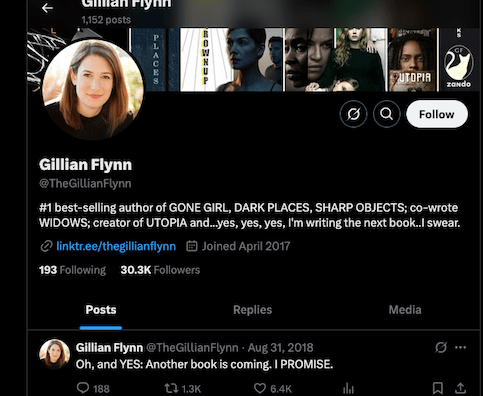
Flynn was born in 1971, and spent her twenties and early thirties working at Entertainment Weekly. She’s described how she was an oddity as a Midwesterner, in a sea of “Ivy League graduates and a lot of boarding school and a lot of east coast.” In 2008 she was laid off and mused about going back to waitressing, the only other job she’d held, since the media world was collapsing. Instead, she wrote novels. Within a few years she was able to draw on her magazine days in her third book, Gone Girl.
You may recall that Amy loses her fairly insubstantial job writing quizzes for a women’s magazine, and that’s okay, as she has a trust fund and a Brooklyn Heights brownstone. But then her husband Nick loses his job at a Maxim-like publication, and he lounges around the house, drinking too much and littering the living room with Chinese food boxes. That’s not so great. The things that Amy found attractive about him largely disappear, because Morose Nick is not much fun.
Amy’s psychologist parents, who’ve made a fortune on their series of “Amazing Amy” kids’ books, confess that they’re broke. The brownstone was her wedding present, but it has a huge mortgage she didn’t know about. They need her trust fund, please and thank you, to survive. So Nick decides that they’re moving back to his Missouri hometown, to look after his sick mother. He opens a bar, using what remains of Amy’s money, with his twin sister. He takes on a part-time teaching gig, which strokes his ego more than it pays a living wage. He starts an affair with a comely young student.
This is the back story that explains why Amy Dunne takes rather drastic steps as she re-envisions her life. Out of work, out of love, and no longer wanting a baby with this man, she comes up with a pretty interesting plan. All it requires to execute is a fake 300-entry journal, some very careful staging of a crime scene, and an elaborate scavenger hunt, with clues whose meaning will be fully understood only by Nick. It’s a fun book, and I think the two first-person narrators are believable. They’re both wretched humans, but that doesn’t trouble me.
I am more bothered by the events near the end of the novel, when Amy fakes captivity and serial sexual assault. We learn that she has a history of feigning rape. Allegations, or rather myths, of women lying about sexual violence have a broader social context. One which includes hundreds of years of legal history, when complaints of assault without eyewitnesses couldn’t even be prosecuted.
Joan Smith, writing way back when about the film adaptation, was censorious. I largely agree with her point of view: “one of its key themes is the notion that it’s childishly easy to get away with making false allegations of rape and domestic violence. The characters live in a parallel universe where the immediate reaction to a woman who says she’s been assaulted is one of chivalrous concern. Tell that to all the victims, here and in the US, who have had their claims dismissed by sceptical police officers.”
Smith’s is an important perspective because she’s both a feminist academic and a crime writer. She touches on that here, noting that when she began writing mystery fiction with her Loretta Lawson series, “I was conscious that the genre was full of stereotypes. I thought many of the female characters were decades out of date, so I gave my protagonist a proper job–she’s an academic–and strong political views. Other writers were doing something similar, creating female characters who weren’t always admirable but behaved like real women. Gone Girl does the opposite, playing on what we now know about the behaviour of abused women and undermining the credibility of victims.”
Smith does acknowledge, however, that the book is significantly more clever than the flattened version presented in the film. Flynn achieved a trick with the first-person narration that doesn’t really translate to the screen.
From fiction to real life, by way of late-middle-age career crises. The New York Times is announcing that my generational cohort faces retirement without enough savings, and many of us in our late 40s and 50s are having to do a career pivot. Their focus is media and advertising, but I think this is a longer list of vanishing and contracting professions. Add academia, for one. In Canada, hundreds or maybe thousands of jobs of college instructors will disappear this year.
I thought I was going to be on research and writing leave in the fall; I’m following through with my plan, but it’s now of a decidedly different character. I’m hearing from friends in law, and even medicine, that there are concerns about how generative AI will “disrupt” their fields. I don’t know if this link will work for everyone, but it’s worth a try if you’re interested: https://www.nytimes.com/interactive/2025/03/28/style/gen-x-creative-work.html?unlocked_article_code=1.7k4.CUzF.UhlFHsmw9PoC&smid=url-share
The opening paragraphs:
“In Generation X, the 1991 novel that defined the generation born in the 1960s and 1970s, Douglas Coupland chronicled a group of young adults who learn to reconcile themselves to ‘diminishing expectations of material wealth.’ Lessness, Mr. Coupland called this philosophy.
For many of the Gen X-ers who embarked on creative careers in the years after the novel was published, lessness has come to define their professional lives.”
Well. Lessness. The oddity of my career is that much of what I’m proud of, I’ve accomplished despite the circumstances in which I’ve worked. But perhaps that’s not odd–perhaps it’s normal? I’ve had a series of teaching-only positions that inhibited research, in more or less overt ways. I remember a job where I was told that doing research would make me look like I was imitating research faculty, which would be inappropriate. I should know my place.
So I revved up publishing, because I’m just that stubborn, and I have a series of printed writings that get cited occasionally. Most of them are about Alice Munro, which has become a whole thing for me. I had a grad course on irony with the extraordinary Linda Hutcheon, and that may have been the best professional preparation for my career.
My workplace is undergoing a process called “canvassing,” seeking people who will negotiate to depart from their jobs. If this doesn’t produce the required numbers, layoffs are next. It’s multiplied across the entire college sector and there’s grim news at universities, too. Last fall saw many, many changes to Canadian immigration policy. Those have made higher education in this country, especially college-level (as opposed to university degree-level) studies, far less desirable to international students. Throw in ongoing national tensions with the two major source countries for students in recent years, and things are bad.
Amy Dunne’s plan includes suicide, after a suitable interval of crowing over her philandering husband’s fate. What strikes me about the character is that, for someone so creative and determined, she gives up on herself awfully easily. Flynn explains this largely by demonstrating how passive she is in her own life, in many ways. That’s at odds with the people featured in the New York Times article, who pivot and hustle and do all the things required to stay afloat in these times, economically.
A prosecutor has pointed out that in real life, the ending of Gone Girl might have involved Amy on trial, at least in a civil case brought by Desi’s mother. This is an interesting take, but also imagine if she’d applied her creativity to fiction. At the core of Gone Girl is writing to beguile, to persuade, to create a powerful narrative. Amy’s invented diary demonstrates that she had the potential to write more than women’s magazine quizzes, and that’s a nice meta aspect of the book. Flynn’s writing job disappeared, so she created a better one.
 The Landscape of Canadian Women's Crime Fiction
Leave a comment