I didn’t recall that Agatha Christie had visited Canada, including Victoria, in 1922. She was travelling in the company of her faithless first husband, Archie. The second spouse, Max Mallowan, sounds much nicer though his archaeological expeditions were expensive to finance. At the time of her Canadian tour, Christie had produced only two novels: The Mysterious Affair at Styles, which introduces Poirot and his good friend Hastings, and The Secret Adversary. Murder on the Links would come out the following year.
But much of her best fiction was written after her first marriage ended, and she’d survived the notoriety of her mysterious disappearance. So money was tight during this trip. Their ship passage was covered, but they needed to pay some of their own expenses. Archie was given an allowance. Agatha wasn’t. David Suchet recounts that during the tenth and final month, they arrived in Victoria, BC, and stayed at the august Empress Hotel. Agatha Christie was so short on funds that she devised the strategy of stuffing herself at the breakfast buffet, so it would tide her over until evening.
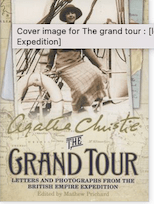
Travels with Agatha with Sir David Suchet contains many such anecdotes, likely drawing on The Grand Tour: Letters and Photographs from the British Empire Expedition 2022. It was a round-the-world jaunt to the various British “dominions”, with the first several episodes covering South Africa, Australia, New Zealand, and Hawaii. And then on to Canada, before returning home. Their toddler stayed in England with Agatha’s sister, something I can hardly imagine.
A terrific blog post here about the trip, drawing on the book, which is by Christie’s grandson. The expedition was drumming up enthusiasm and soliciting contributions for an imperial exhibition to be held in 1924-25, now a full century ago, at Wembley Park. Pavilions represented different nations, some in offensively stereotypical ways, to the point that Nigerian students in London protested. People were brought over from their home countries to become part of “living” displays.
In Anne Clendinning’s excellent article about Canada’s participation, she notes that the exhibition presented an opportunity for the display of a unified and confident national identity, with the goal of furthering economic investment. Yet she suggests that the image of Canada produced was ultimately “contested, fragmented, and sometimes controversial” (82). The Group of Seven’s paintings were prominently displayed, and A.Y. Jackson sold one to the National Gallery. Images of wilderness jostled with depictions of thriving metropolitan regions.
Appallingly (and yes, it was a century ago, but still) “the most visible nod to the First Nations was a butter sculpture of Edward, Prince of Wales, ‘in the dress of a Red Indian’” (83). Another butter sculpture of the Prince of Wales–dairy products were clearly getting a hard sell–depicted him with a horse at his Alberta ranch. One wonders if a current prince and princess might have faced less ire if they’d settled for an Alberta ranch, rather than a California mansion and a series of Netflix ventures that prompt smugly critical reviews.
Suchet says he’s intrigued that the account of Christie’s time in Canada includes no mention of Indigenous nations, and he interviews Ktunaxa people about the St. Eugene Residential School and the impact of colonization. It’s an interesting site, because the community decided not to raze the building but to renovate it, so it’s now a resort/casino with an educational centre. Listening to Sir David Suchet speak to Sophie Pierre, and to young Ktunaxa people who are learning their language, is a highlight of the episode.
I’m hoping for a second season of Suchet’s program focusing on the middle eastern countries where Christie travelled, apparently gamely, to spend hot seasons in the company of archaeologists digging up things. Of course she drew inspiration from these trips, with books like Murder in Mesopotamia and Death on the Nile.
But in Canada, things were rather tamer. The trip here started in Victoria with a visit to the Dominion Astrophysical Observatory, which had a new giant telescope to explore the mystery of the stars. The night Christie visited, alas, seems to have been cloudy. They went on to other B.C. destinations such as Vancouver and Vernon. An epic CPR journey took them across much of the country, including a stop in Banff, Alberta. Christie felt it was one of the most beautiful places she’d ever seen.
Sir David Suchet is a pleasant and enthused guide to Christie’s travels, and his raptures about the Rockies are entertaining. He takes the expensive Rocky Mountaineer, which may be a more pleasant way to travel. My trip from Vancouver to Prince Rupert went through Jasper, since there’s no Banff option on Via, and was subject to hours of delays as we pulled off to side tracks so freight trains could speed past. Still much fun, and my heart breaks for Jasper. The Rocky Mountaineer will give you a very different experience, with a full daytime trip through the mountains.
Now I’m digging through Christie’s fiction in search of references to Canada. In one of my favourite novels, Five Little Pigs, a young girl is whisked off to Canada after the notoriety of her mother’s murder trial. Allegedly she killed the girl’s artist father. Now that she’s grown up and planning to marry, the daughter wants Poirot to investigate her past, and determine whether her mother was guilty of the crime for which she was hanged. Other references?
 The Landscape of Canadian Women's Crime Fiction
Leave a comment