
This week, a fellow seeking to be the next Prime Minister of Canada had to apologize to Nathalie Provost. A survivor of the Montreal Massacre, she has been a vocal advocate for gun control and is running for the federal Liberal party. Great non-partisan news! However, Mark Carney referred to the site of the violence on December 6, 1989 as Concordia University, and then mispronounced her name.
In 1989 Carney was at Oxford, having recently graduated from Harvard. Over the course of his career, he spent a number of years outside the country, and I have no doubt that his frame of reference is broader and richer because of that. But it may mean that events like those at the École Polytechnique are less vividly imprinted on him, because he had less geographical proximity. Or it was a minor, human glitch, the type that we’re all more prone to as we get older and words escape us. Nouns are the first to go, apparently.
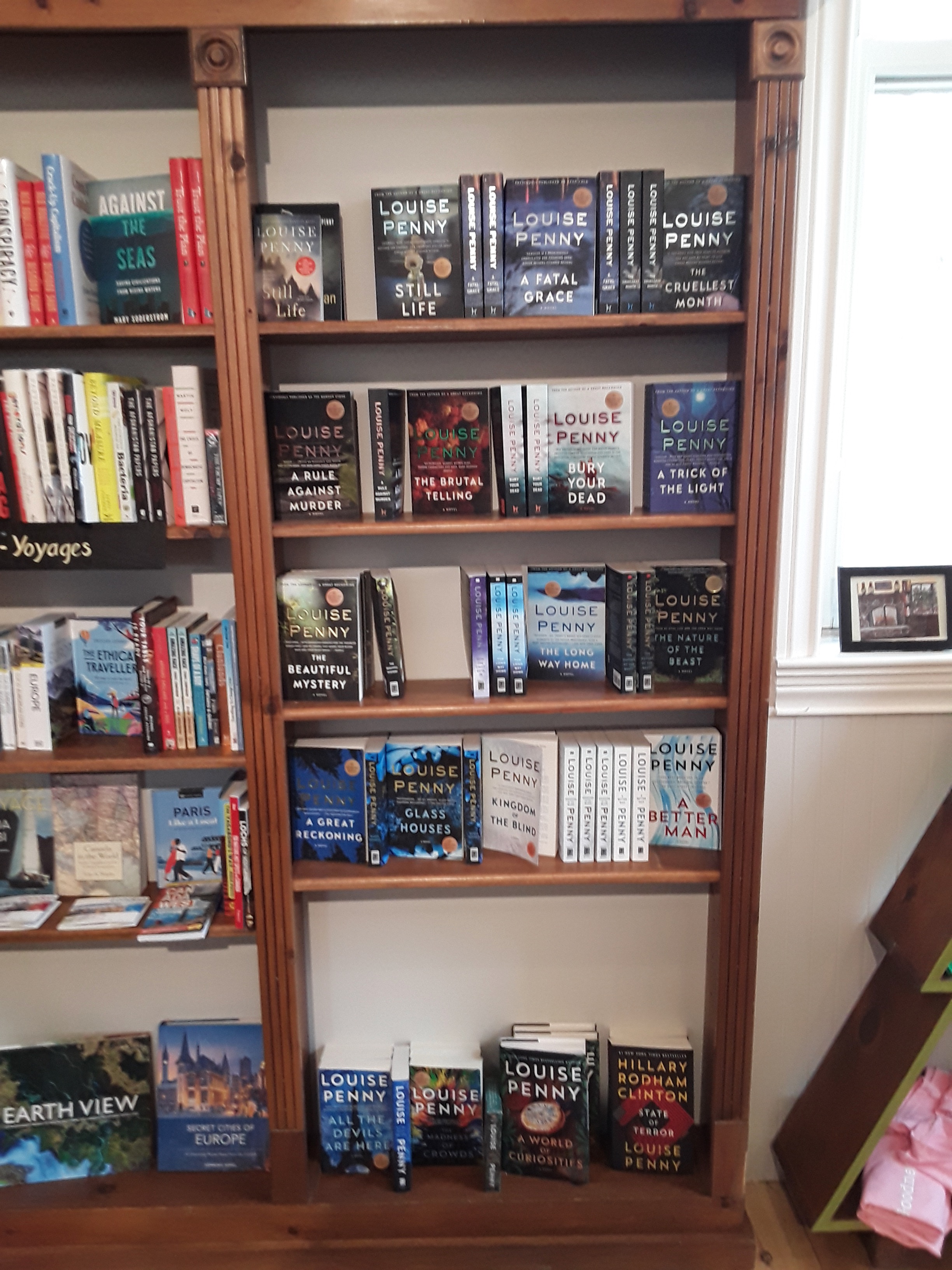
Nathalie Provost is the important part of this news story. She has spent decades working to ensure that the memory of the Montreal Massacre is linked to positive social changes, and a focus on misogyny. Her efforts brought her to Louise Penny’s attention, and Penny sought permission to include the very real Provost as a fictional character in A World of Curiosities.

The novel has some intersecting plots, with a heavy dose of coincidence. Myrna, Three Pines’s bookstore owner and former psychologist, has a niece who is graduating from the École Polytechnique. She will receive her coveted engineering ring and Nathalie Provost will be speaking at convocation. We learn that Provost and Gamache have known each other for decades, as he was one of the first on the scene that terrible day in December. Penny explains this bit of ret-conning in the CBC piece linked to above.
“I wanted to give Gamache his origin story–how he ended up not only in homicide, but how he ended up hating guns,” Penny said. “He hates guns because he saw at the Polytechnique what they do.”
But Penny also wanted to re-visit the controversy about the meaning of the Montreal Massacre. In its immediate aftermath, a range of mostly-male politicians and journalists sought to dismiss murderous misogyny as the precipitating cause. The perpetrator was unsubtle. He had a hit list of prominent women; he told his victims that he was killing them because he viewed them as feminists; he separated male and female students.
Still, the narrative of “isolated incident” and “lone madman” was quickly constructed. This did turn out to be a more complicated story, as the memoir by the murderer’s mother makes clear. An abusive husband and father, a legal name change, perhaps an experience of Quebec ethnocentrism, deep resentment towards his mother and sister. All this and failed scholastic hopes. Like many others before him, who didn’t turn to mass murder.
A World of Curiosities, I noted above, has additional plot strands. Another of the young engineering graduates is a former child victim of terrible abuse. Years ago, during their first case together, Gamache and Beauvoir encountered a pair of damaged siblings. The body of their mother had just been identified, but the young son and daughter seemed indifferent. Now they’re adults and Gamache worries about their potential for violence.
And there’s yet another plot strand, the discovery of a mysterious painting modelled on the Paston Treasure. That one gets rather baroque, but I love what Penny does with the painting alluded to in the novel’s title, and the plots are ultimately yoked together.
I’m reading a novel by Donna Decker that fictionalizes the events of the Montreal Massacre, and it comes with an endorsement by Provost. Dancing in Red Shoes Will Kill You takes its title from an Atwood poem, “A Red Shirt.” But way back in the early 90s, I remember hearing Atwood talk about the impact the film The Red Shoes had on her when she was young, with its intimation that creativity is fatal to women.
Rosemary Sullivan, of course, drew on this allusion as the title of her biography of Atwood’s early life and career. (Here’s an interesting thing–since Sullivan’s book, and Nathalie Cooke’s, no further Atwood biographies. We’re getting a memoir “of sorts” in November.) The poem’s long and I’m sure that quoting more than a fragment is not permitted, so . . . a snippet of a lovely work:

In Decker’s novel, the analogy to dancing in red shoes is daring to be a woman engineering student. Especially in 1989, in a prestigious and competitive faculty, and in a world where sexism is still baked into academia. Her characters include several young students as well as a journalist, who has been conducting research about gender bias and misogyny in higher education in Canada. Back in the late 80s and 90s, inclusivity was not on the radar of engineering faculties, as far as I know.
The small numbers of female students put up with plenty of sexist nonsense. For a fiction project, I’ve been re-visiting the campus misogyny of this era, and it’s grim reading. It’s been 35 years since I started undergrad myself. I’ve spent nearly all of them in Canadian higher ed, with brief forays into other work, and a term spent as a visiting grad student at NYU. Today I’m drafting what’s called a canvas proposal because my college, like every college in Canada, has lost a raft of international students. So now we will lose jobs.
I have some idea of what’s next, but not very much. I’ll finish a creative nonfiction project that will complete my U of T certificate program. I’ll try to finish this book, although losing access to research library privileges will be tricky. My generous friends are figuring out a plan so that I can be affiliated, to an extent, with a Toronto institution next fall. But endings and beginnings are inevitable. Despite a very bumpy career trajectory as a contingent faculty member for most of these decades, I have had a lot of fun teaching English literature and writing.
No regrets, at least not today. And I am so grateful to be working on projects that engage me deeply.

 The Landscape of Canadian Women's Crime Fiction
Leave a comment