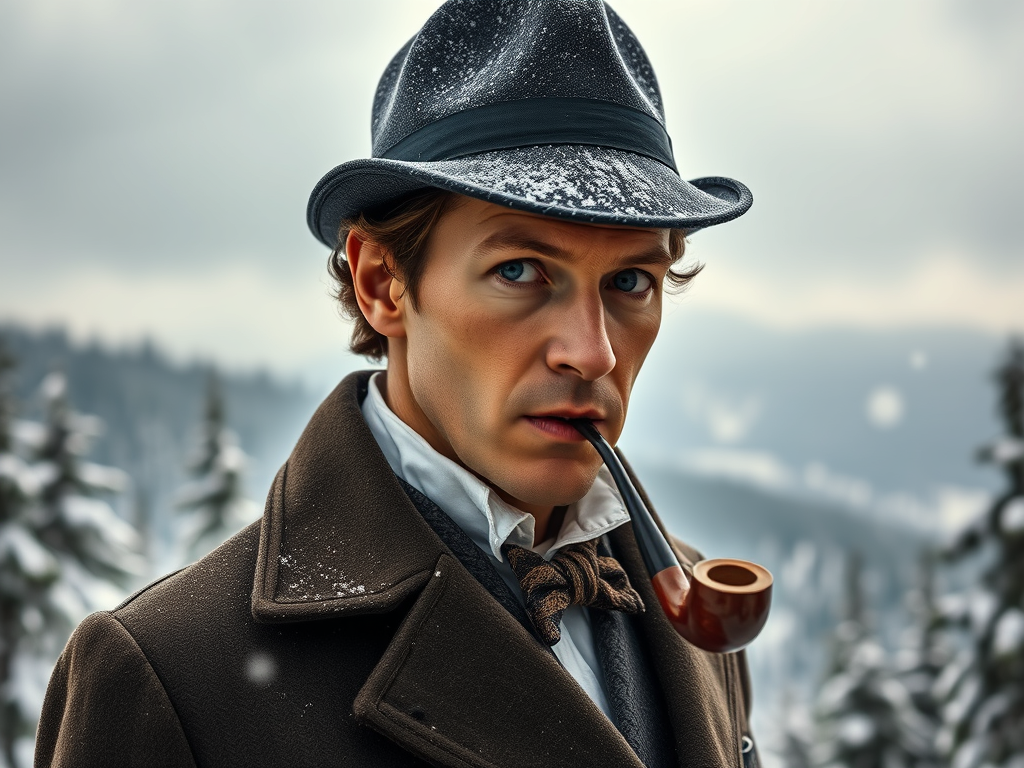
Well, this is fun. (Not sure about the AI-generated image, however, based on a prompt of “Sherlock Holmes in Canada.” The hat’s all wrong.) This is courtesy of Jackie Shead’s Atwood book, which includes a reference to a historical curiosity of a story, first published in the Globe & Mail nearly a half century ago.
Michael Bliss was, when I was a student at U of T, just about the best-regarded historian of Canada. Jack Batten is a lawyer who wrote on famous trials, and I really enjoyed his work, way back when. In 1977 they co-authored a short story entitled “Sherlock Holmes’ Great Canadian Adventure.” It brings the London detective to Canada in early 1891, where he–according to his Boswell, the faithful Dr. Watson–“saved Canada from annexation to the United States.”
I think it’s pretty good pastiche. They capture Watson’s voice nicely and have fun dropping in references to Moriarty, and other Holmesian personages and cases. “I never knew you to be concerned with the colonies,” Watson remarks when Holmes announces his plan to travel to Canada. But Sir Charles Tupper pleads with the detective, on behalf of Sir John A. Macdonald, to intervene in an upcoming decisive election. That may relieve Holmes (for a time) of worrying about the scourge that is his arch-nemesis. So Canada it is.
Some choice quotations:
“Canada is singularly backward in the occurrence of interesting crimes.”
“Is your Sir John A. Macdonald a sober, reliable man?”
“Montreal’s winter recreations struck me as singularly abandoned . . . I witnessed tobogganing down lengthy and treacherous slides carved into the snow in the city’s principal park . . . I saw very combative curling matches on the ice of the St. Lawrence River.” And that’s not to mention the hockey match that Watson describes with interest.
The premise is that senior Liberals are plotting, unbeknownst to the young Wilfrid Laurier, to compromise their nation’s interests and cede the country to the United States via annexation. Watson worries that this may be beyond Holmes’s considerable talents, but the investigator himself has no such qualms. Of course he performs admirably.
Batten and Bliss manage to fit in a critique of how dominated Canadian newsstands are by American publications (plus ça change), and there are descriptions of old Toronto landmarks. Holmes dresses up as a credible American southerner and fools Watson, and then the detective adopts a stance of “agent provocateur,” as Watson terms it. He nimbly thwarts the threat of annexation, with the election results in favour of the Conservatives.
Perhaps he’ll return to our aid once more, if only fictionally.
 The Landscape of Canadian Women's Crime Fiction
Leave a comment