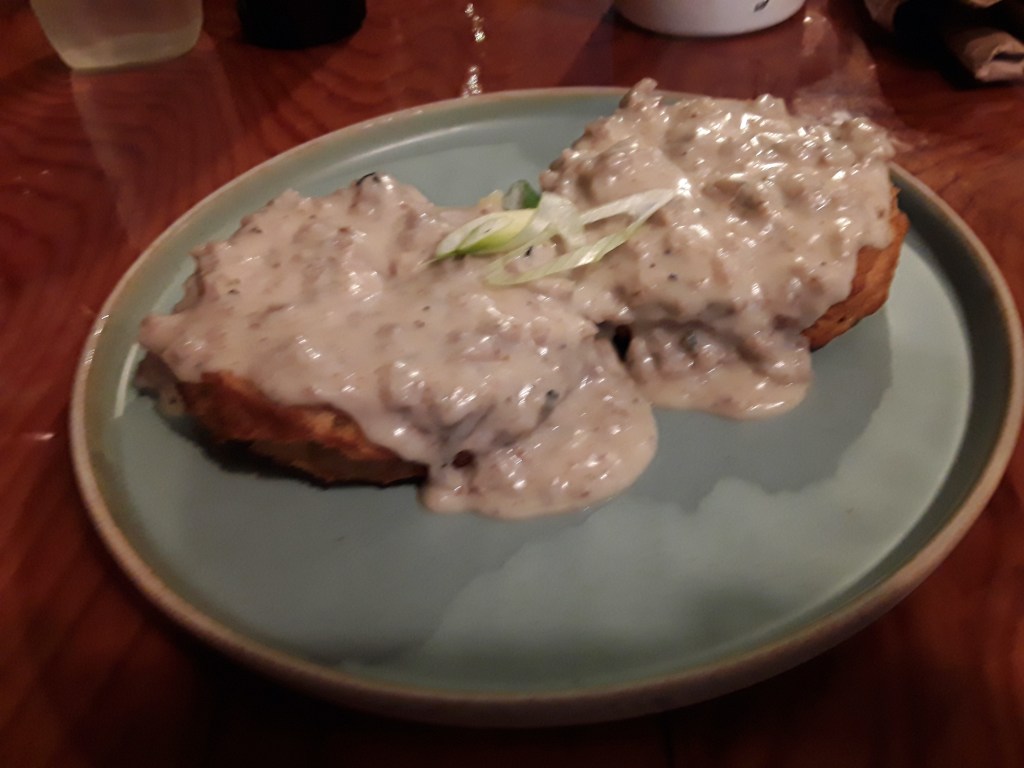
I won’t start eating biscuits and gravy or grits for breakfast every day, but this was a nice change on a very rainy late-March morning.
One of my mother’s favourite songs to sing us was “Mama’s little baby loves shortnin’, shortnin’”, a ditty which I’ve only recently realized was deeply problematic. The version I learned went “stole the skillet / stole the bread [sic] / got six months in jail for shortnin’ bread.” There are several versions of the lyrics in recordings, by artists as diverse as the Andrew Sisters and The Cramps. Yes, really.
This is my long way around to discussing how race and regionalism intersect in the history of southern cooking. And, in turn, how they inform crime fiction by writers ranging from Margaret Maron (North Carolina) to James Lee Burke (Louisiana) and Walter Mosley (California). I’m skipping past a number of other significant southern mystery authors, including the extraordinary writers S.A. Cosby and Attica Locke. Additional info on them soon.
I’m a big fan of Edna Lewis, and Bryant Terry’s magisterial Black Food is a treasure trove. It’s wonderful to see how Jamila Robinson has been transforming Bon Appétit, to include far more focus on American regional and cultural cuisines. For a time, I had opportunities to eat in Harlem and Greenpoint, Brooklyn. That was due to a breathless term at NYU, studying African American lit with Elizabeth McHenry, and then annual visits for an MLA committee. I miss those days. Ex-southerners had blended culinary traditions with northeast ingredients.
Spending next fall in Toronto will accord me diverse eating opportunities, although I’m feeling leery about trips across the border. But much of what I know about southern food is courtesy of Margaret Maron‘s Deborah Knott series, set in North Carolina. My mother-in-law introduced me to the series and to the local delicacy of pecan pralines, which we still order for Xmas, sometimes alongside a famous Pecan Praline Cake that feeds multitudes.
I was immediately taken with Bootlegger’s Daughter, the first novel in the series, which features a female lawyer running to be a judge. One of her campaign challenges is the reputation of her father Kezzie, a former outlaw. Another is that the majority of her sprawling family would rather see her married and raising children.
Most of the serious cooking in these novels is performed by a Black couple keeping house for the elderly but still irascible Kezzie, whose home is the gathering place of several generations. The relationships between white employers and Black employees are warm, but shot through with consciousness of racialized histories of power and property. Here’s an engaging M.A. paper about Maron’s fiction, which captures several of the elements that beguile her readers.
Maron’s other series is set in New York and features a female police officer, Sigrid Harald. It’s an engaging saga, but Sigrid’s life is comparatively lonely and isolated. I prefer the clamour of Deborah’s large network, and the careful way that Maron pushes back against stereotypes of southerners, even while acknowledging that the “new south” has some old problems. In a 2017 interview with the LARB, Maron had thoughtful observations about the role of the writer in political activism.
“Basically, I just see myself as a citizen who wants the fairness of a level playing field for everyone. I’ve been saddened by the mean-minded backward path North Carolina has taken in the last few years. Resegregation along economic lines is a reality, as are the efforts to curtail the reproductive rights of women, the redistribution of wealth from the middle class to the one percent, and redistricting to achieve voter suppression. Usually, I content myself with letters to the editor, but sometimes it does spill over into the books. I’ve never wanted to use my books as a soapbox, yet funding for mental health, better schools, a more humane medical system, fairer taxes, or sensible drug laws that are less about punishment and more about rehabilitation can make me forget that I’m supposed to be entertaining, not preaching.”
Maron passed away four years later, at age 82. There are various loving tributes online by fellow mystery authors, as Maron did a lot for Sisters in Crime and helped mentor dozens of writers. As the Times obituary describes, Maron’s early crime fiction was prompted by real life:
“‘My first novel grew out of my experiences working in the art department at Brooklyn College and watching the way the acids and photographic chemicals were mishandled,’ she told The Chronicle, the campus newspaper at Duke University, in 2011. ‘There was a poison cabinet that anybody could get into.’
‘And so in the novel,’ she continued, ‘I put potassium dichloride into a professor’s cup of coffee.’”
Food and drink are less noxious in the Deborah Knott series, which is full of church potlucks and political fundraising barbecues. Maron draws on her own upbringing and memories of multi-generational feuds, tobacco fields, and race relations. But there are sweeter portrayals of family and fellowship, meals cooked in cast iron pans and served under the trees. This is a mouth-watering set of books, and it makes me long to sit on a porch with sweet tea and a slice of pie.
Maron’s novels include some gritty and graphic crimes as well as ancient tragedies that have been kept secret, resurfacing to rupture relationships. Many of the novels feature the antics of Deborah’s near and distant kin, or the cases that come before her in court. Some turn back to her own troubled late adolescence, after the death of her adored mother. In the later books, she finally marries the sheriff she’s loved for years, and becomes a doting stepmother to his young son Cal.
The plots are carefully constructed, and the setting is drawn deftly and memorably. I would highly recommend the series.

 The Landscape of Canadian Women's Crime Fiction
Leave a comment