In the new documentary The Day Iceland Stood Still, director Pamela Hogan revisits October 24, 1975, when 90% of Iceland’s women walked off the job–at work and at home. For one day, they insisted, men could pay attention to how much they did, and how little their contributions were appreciated and rewarded.
On International Women’s Day fifty years later, I’m contemplating the potential benefits of walkout of various kinds, both domestic and professional. Sometimes women need to say enough and withdraw from our obligations and commitments, especially when it feels like we are holding up an ungrateful world.
A few weeks ago, I chatted with our postal carrier on B.C.’s Family Day. I hadn’t realized that federal employees in B.C. don’t get the provincially-mandated holidays, and I proposed a one-woman wildcat strike so she could hang out with her kids. “Two women,” she laughed, gesturing at me and the laptop I was carrying. I’m in.
Eliza Reid is a Canadian who grew up near Ottawa, but has now lived in Iceland for more than twenty years, having moved there for a relationship with the man who ultimately became Iceland’s president. She raised four children while undertaking the unpaid ceremonial duties expected of the president’s spouse, and very fun projects like the creation of the Iceland Writers’ Retreat.
Several months ago, I picked up her account of women’s achievements and the quest for gender equality in Iceland, mostly because I was interested in the outsize influence of Icelandic women composers. There’s Anna Þorvaldsdóttir; here’s a bit of her Catamorphosis. But there are many more, and women’s contributions in other arts spheres are equally impressive.
The Icelandic crime story, conversely, still seems male-dominated. But this is not an area of expertise for me, and I may just be noticing the tremendous impact of Arnaldur Indriðason. I’m wishing I’d known about UVic’s course this term, and am looking forward to a public talk about Indriðason next week. And Eliza Reid has contributed to the growing Icelandic crime literature and, conveniently for me, Canadian women’s crime fiction.
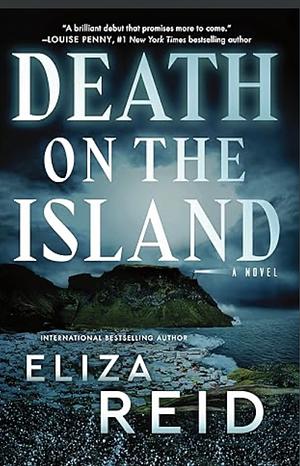
Her first murder mystery is titled Death on the Island, and alas, I’m finding it a bit of an earnest slog.
Part of the issue is the novel’s protagonist Jane, the wife of Canada’s ambassador to Iceland. Reid uses a third-person narrative form to canvass a number of key characters, perhaps too many of them, but Jane has privileged status. She’s really dull, or at least, we don’t learn enough about her to have a sense of who she is and why we should care. Apart from her anger at her husband, who seems singularly lacking in both sense and manners.
The premise is intriguing; a delegation from the Canadian embassy has travelled by ferry to the Vestmannaeyjar archipelago, for the opening night of an exhibit by a Canadian scientist turned artist. Now she’s interesting. Passionate and engaging and devil-may-care. A storm disrupts their travel plans and they are stranded, while a dinner to celebrate the event is fatally affected by the sudden death of a Canadian diplomat.
This book. Moves. Slowly.
On the one hand, place is depicted beautifully. Vestmannaeyjar has had devastating volcanic activity that once displaced the entire community, and Reid does a lovely job of portraying the impact of geography on character. But the murder investigation, initiated by what appears to be a solo and very young police officer, feels oddly desultory. And characters behave in some odd and random ways.
“As they unearthed an increasing diversity of material, Jane thought this was finally becoming more interesting,” Reid writes. In this scene, which takes place over halfway through Death on the Island, Jane is sifting through a dead man’s papers on the floor of his chaotic home office. She’s in the company of a Booker-winning author, a distant relative of the man whose files may shed light on his death eight weeks earlier.
His grieving widower, the town’s mayor, insists it was a murder. He has also left these materials undisturbed, even though he is convinced his husband died of an assault, not a cardiac event. Yet he permits two near-strangers to claw through decades of personal and professional materials? That feels off, to me.
But back to Jane for a moment, because it’s frustrating that Reid sounds so interesting compared to her alternately timorous and determined character. She demands divorce one moment while wondering, in the next, if she isn’t too hard on her poor husband. I appreciate ambivalence, but this needs a more nuanced approach. And if her husband is truly so incompetent, I despair for Canada’s foreign service.
I’m being extra critical, I think, because there are pages and pages of breathless testimonials about the brilliance of the novel. Perhaps that comes out in the final 40%? I’ll update tomorrow, when I finish reading.
Update
Things did not improve. Some worsened. However, a thought is niggling at me: the chef’s name, Piotr, seems like an almost-anagram of Poirot. I kept expecting that to be significant, but maybe it’s random?
One aspect of the novel merits more praise than I provided above. There’s a great set piece in the scene at the acclaimed local restaurant. A chef keen on foraging puts together a signature drink that is part spectacle, part bragging rights, due to its potency. But then . . . I don’t want to spoil a novel that isn’t yet in print, but I’ll say that we really only needed the scene once.
A fun fact on the topic of Icelandic women composers. As Reid’s previous book notes, a large swath of the population stayed awake to witness Hildur Guðnadóttir receive the Oscar for best film score, for Joker.
Of interest to mystery fans is that she scored a rather lamentable Poirot adaptation, A Haunting in Venice. I thought the film’s sound and music work may have been the best parts of a peculiar project, the adaptation of a not-great Christie novel. With tweaks, it produces a baroque film replete with Venetian palazzi and a fun poison garden.
Confidential to KB, there are better Agatha Christie novels than Hallowe’en. And while I love that you cast brilliant women actors of a certain age, you keep casting yourself as Poirot. But you were Wallender, and so this is baffling to some of us, because there are more obvious choices for Poirot.
A modest proposal. Go back to the drawing board, find a new Poirot and/or new Marple, and take on a few of the big stories like Roger Ackroyd. You could start with a younger Poirot, so he can age over the stories.
Or, if this displeases you (and may I say how very much I appreciate your takes on Shakespeare?), what about directing Emma Thompson in films worthy of her talent? Ideally these would feature Alan Rickman. Failing that, faute de mieux, what about pairing her with Jude Law as a romantic interest? Women my age would turn out in droves, to see a film where a woman 10+ years older than a man isn’t cast as his mother.

 The Landscape of Canadian Women's Crime Fiction
Leave a comment