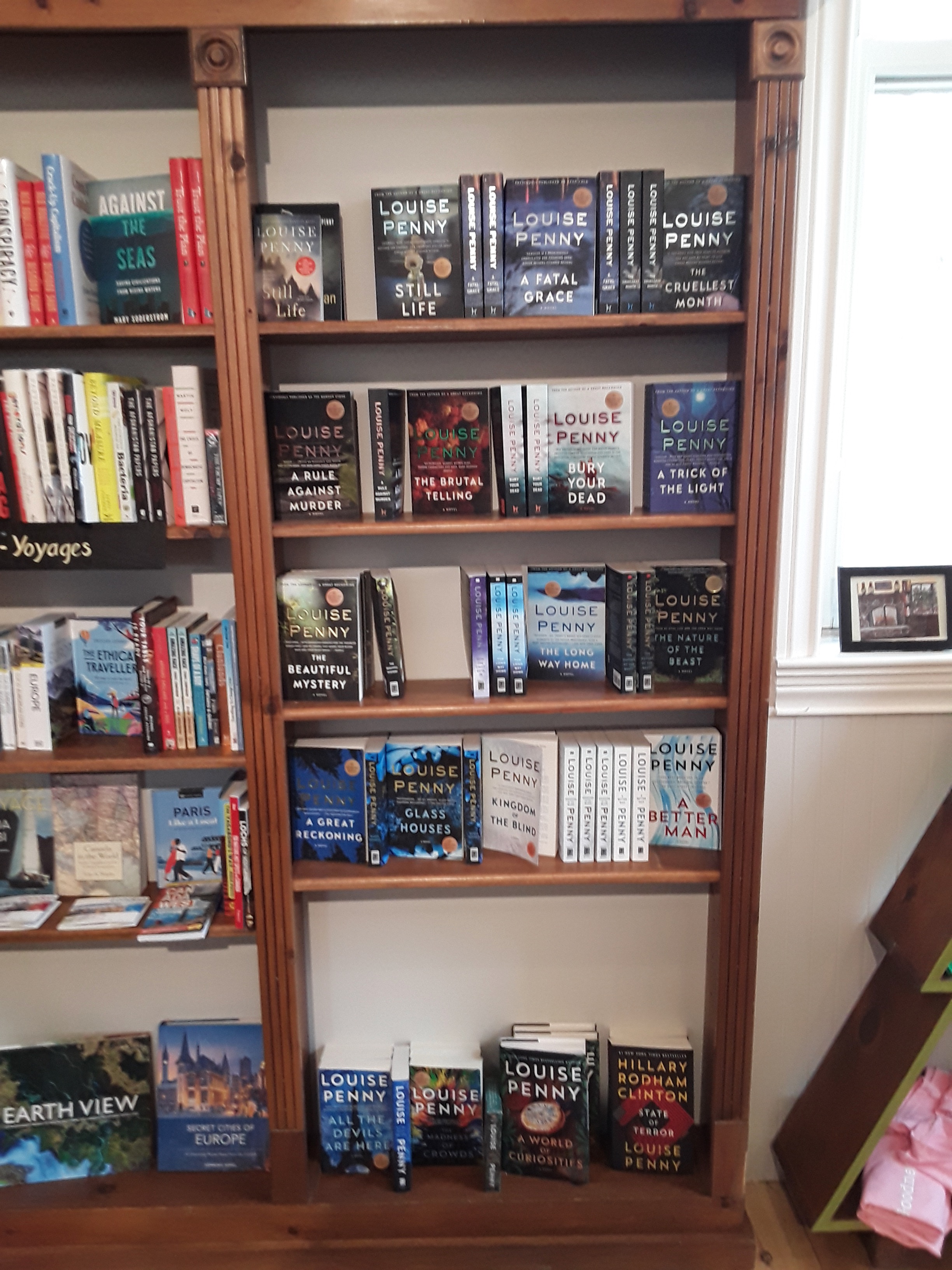

I don’t typically accumulate a substantial number of mysteries when I’m already in the midst of reading several new books.
And I need to finish up Eliza Reid’s Death on the Island (with thanks to NetGalley for the preview) and Janice Hallett’s art school-email mystery, which manages to make an LMS messaging tool interesting.
But I stopped by one of Victoria’s lovely independent bookstores today to check if the owner could keep an eye out for a rare book for me, and she had a shelf of Sayers novels marked down to $3 each, and so . . . .
The lamentable aspect was that I then staggered home under the weight of sixteen books (all paperbacks, fortunately), because my previous stop had been at another terrific independent bookstore. They had the complete set of recently republished L.R. Wright volumes from the Karl Alberg series, the series tie-in edition for the not-as-bad-as-it-could-be Fox adaptation. This seemed like an opportunity, and I carped the diem and then had regrets about my decision to walk home via Sorensen’s Books, on the cherry blossom route of downtown Victoria.
But all is well and the weekend in the garden will be supplemented by much L.R. Wright and Dorothy L. Sayers.
The two series are very different.
Wright’s down-to-earth RCMP officer is a divorced father of two, while Sayers’s titled hero is (for much of the series) a never-married man about town.
L.R. Wright’s Sunshine Coast-set British Columbia novels are extraordinarily attentive to place. Dorothy Sayers sets her scenes in ostentatiously class-oriented interiors rather than in the English landscape, which is only sketched in lightly in most of the novels.
But there’s one especially appealing similarity of the Alberg and Lord Peter Wimsey series: both women writers give us an appealing romantic interest. I don’ t mean just a piquant love story (because some of us are perfectly content for mysteries to not dabble in romance at all, and don’t get me started about romantic suspense). Rather, I appreciate a heroine worth of the hero–and vice versa.
I’m reminded of Scotland Yard’s Adam Dalgliesh and “his Emma”, as she is frequently referred to in the later P.D. James novels where the poet-detective courts a Cambridge English lecturer.
He does a poor job of it, initially, cancelling dates and failing to show up on time, thus earning himself a dressing-down by Emma’s close friend.
But he eventually shapes up and overcomes the diffidence he shows in his earlier and rather distressingly cool romantic entanglements.
James explains his lack of passion and investment in those relationships as the consequence of his immersion in his work and his poems. But the loss of his wife and infant son in childbirth seems also to be a factor in placing him at a remove from the women in his life.
Adam is so solitary a figure that one worries about him. Is he eating properly or surviving on cheese and toast and bad pub dinners? Should he be taking more weekends off to admire church clerestories and religious art?
If the novels were set a few decades earlier, James would have gifted him a housekeeper or butler to keep his life in order.
Poirot, after all, has his man to press his clothes and arrange his breakfasts; so, too, does Lord Peter.
But Adam is left to fend for himself, domestically, and so Emma, who is lovely and interesting and kind and accomplished in her own right, comes as a relief to readers. Or, at least, this reader.
And Sayers does something similar: she keeps Lord Peter footless and foolish, in his romantic affairs, for several early books. But he falls hard for Harriet in Strong Poison, because what’s not to love about an intelligent and attractive woman on trial for the murder of her last lover?
And it’s Harriet’s diffidence, here, that is the challenge. She doesn’t want to be a kept woman, and he has an inconveniently large income; she doesn’t want to be under his moral and social protection, as a respectable wife rescued from the gallows by her gallant hero, but she does love him.
Not enough to stop writing murder mysteries, but quite a lot.
I’m not a big fan of the Nick and Nora Thin Man movies, because I find them a bit precious and thin on plot (as well as filled with an alarming number of alcoholic beverages), but I’ve seen all of them. When one loves, one shares the other’s passions. Even if that passion is Myrna Loy and an enormous poster of her is affixed, worryingly, to the bedroom wall.
Similarly, Tommy and Tuppence do nothing for me: too much charming and vaguely suggestive repartee before they tuck into their twin beds, and not nearly enough serious investigating.
But Harriet and Lord Peter are a much more satisfying investigative duo.
And so are L.R. Wright’s Karl Alberg and (oh joy, oh bliss!) his librarian-lover Cassandra, who’s also reluctant to marry.
Cassandra has a tough time of it in the series. Her mother’s difficult; she’s kidnapped by a stalker; the library patrons insult her favourite books.
But over the course of the series, as their romantic relationship deepens, Wright has a lot of funny with the character, and with the portrayal of a middle-aged romance.
And we need more librarians in murder mysteries, I think. And in fiction, generally, although this list of 50 suggests that under-representation is not an issue.
Decades ago, more than a dozen young men over the course of several years described my appeal as “sexy librarian.” At the time, I took it as a minor put-down, attributing the characterization to my predilection for glasses over contact lenses.
But Marian the Librarian is, it turns out, an object of lust for some. Intriguing.
Have a lovely weekend of libraries and bookstores.
I’ll enjoy my book hauls nearly as much as I’ll glory in the blossoming of cherry trees in this gorgeous sakura season.
Here’s Canada’s beloved Anne of Green Gables on the glory of cherry trees (which, in my experience, do not bloom at the same time as apple trees, dandelions, and lilacs, but perhaps things are different–or magical–in Prince Edward Island):
“A huge cherry-tree grew outside, so close that its boughs tapped against the house, and it was so thick-set with blossoms that hardly a leaf was to be seen. On both sides of the house was a big orchard, one of apple-trees and one of cherry-trees, also showered over with blossoms; and their grass was all sprinkled with dandelions. In the garden below were lilac-trees purple with flowers, and their dizzily sweet fragrance drifted up to the window on the morning wind.”

 The Landscape of Canadian Women's Crime Fiction
Leave a comment