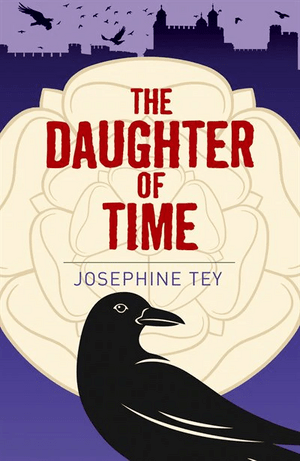
Josephine Tey is best known for The Daughter of Time, which remains highly regarded. A temporarily invalided Scotland Yard detective sets his wits to solving the poignant murders of the little princes in the tower, way back in . . . 1483. A very cold case.
In The New Yorker, Sara Polsky’s “The Detective Novel That Convinced a Generation Richard III Wasn’t Evil” makes a strong argument for Tey’s novel sustaining twentieth-century interest in the case, and in Richard III more broadly. A preoccupation that culminated in the discovery of his remains in the most prosaic of locations, a parking lot.
And until recently, this was the only Tey novel I’d read all the way through. I’m now reading several others with much pleasure. I had to resist the impulse to purchase one earlier today, because of the call to avoid large U.S. retailers in Canada on February 28th, in protest. Instead, I located a library copy and I will open a new account to access the book, because one can’t have too many library cards. The biography of Tey that I’m coveting is more of a puzzle. Canadian library copies seem non-existent, so that will be–sigh–Alibris, tomorrow.
Tey died at 55, after a relatively short illness, and with few outside her immediate circle knowing that she was sick. But her private life, secretive by today’s standards, is rather fascinating. From this same source, here’s an intriguing story about her connection to Sayers:
“. . . on 16 March [1949], Dorothy L. Sayers (writing in her then capacity as Honorary Secretary of the [Detection] Club; she would become President in succession to E.C. Bentley later that same year) wrote to Tey to inform her that she’d been elected unanimously to membership of the Club, which had, in Sayers’ words, ‘no object, except mutual assistance, entertainment, and admiration.’ At that time, the Club met bi-monthly, and Sayers suggested that Tey could attend her first meeting and be initiated as a member in May.”
Membership was by invitation only, and members did not learn of their election until they were informed that it had been achieved. There was no application process. One imagines that the vetting of candidates was rigorous and sometimes, frankly, rather gendered.
But Tey’s response! “‘I have an odd feeling that your charming and unexpected letter has altered the foundations of my life.’ She did, however, emphasize that there was ‘one snag’. What was this? Tey explained: ‘I have reached my present age without making a single speech and I have every intention of dying in that virgin condition.’ Given that she lived in Inverness and had various existing commitments, she wasn’t able to make the meeting in May. Although she’d be ‘in town’ (London) ‘it will only be for a short interval between looking at primroses in Sussex and looking at horses in Newmarket.’ However, she added that if the Club would be prepared to put up with ‘a complete dud (in the speech sense) member who nowadays lives mostly in Ultima Thule’, she’d be delighted to accept the invitation.”
Sayers happily accepted the condition on behalf of the Detection Club, but there seems to be no further record of their correspondence or of Tey’s participation. Tey died just a few years later, on February 13th of 1952, of cancer.
She wrote eight mystery novels, two of which were adapted to film. Six of the books formed her Scotland Yard Inspector Grant series; Brat Farrar and Miss Pym Disposes, which I’m currently reading, were stand-alone mysteries. She published several novels and a number of plays under the pseudonym Gordon Daviot, and this is an aspect of her life/work that I look forward to exploring in more detail. Tey had close London theatre connections and friends, and I’d like to track down these scripts.
Dorothy L. Sayers (1893-1957) was also not exceptionally lucky in her longevity, although my sense of what it is to be elderly has gradually shifted back. Deaths of young people are always tragic, but I used to be relatively sanguine about those who perished in their 60s and 70s. Now that seems like one or two lamentably fewer decades than one should enjoy. I’m re-reading Sayers’s Strong Poison and very much enjoying an academic book by Megan Hoffman (part of Palgrave’s Crime Files Series, about gender in Golden Age crime novels), in which she discusses the work with substantial insight.
Sayers has been on my mind because I’m researching Oxford Gaudies for another project. As a non-party-attender who is now freed of all social obligations by chronic illness, I’m a bit baffled by the appeal of dressing up and spending hours dancing and drinking. Surely those are things one can do alone, or with one’s smallest circle? My Oscar party this Sunday will feature all of two guests, and one of them’s a maybe.
Sayers was exceptionally well educated. Her father began teaching her Latin when she was six, oh lucky child, and she went on to study Modern Languages at Oxford’s Somerville College. Her Gaudy Night is about the plight of highly educated women, in a world that rarely appreciates their braininess. As an undergrad I was very taken with the book.
It now seems awfully snobbish in its portrayal of the class system and the college scouts, but it’s still a fun read. There’s lots of editorializing about women-only colleges and women’s education, and then there’s the hapless Lord Peter Wimsey, hovering in the background and hoping to persuade Harriet Vane to marry him. Her objections are reasonable, and I wish Sayers hadn’t married them off. But I’m in a mood. In other moments, I find the post-marital novels rather delightful.
 The Landscape of Canadian Women's Crime Fiction
Leave a comment