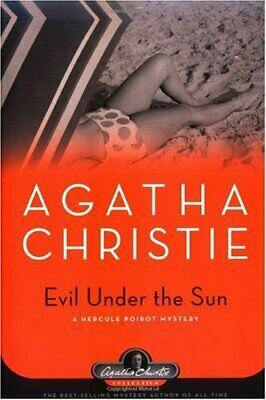
I’ve been on a Christie binge, and yet once more. I’m re-reading Evil Under the Sun while alternating 4.50 to Paddington and Dead Man’s Folly as evening viewing. Interspersed with The Magpie Murders, which is terrific, but moves along at a very stately pace. There’s a Japanese adaptation of 4.50 to Paddington that I’d love to see.
But to start with Evil Under the Sun, Christie gathers together holiday-makers on a piratically-themed Devon or Cornwall island. Improbably, Poirot is of their number along with a beautiful and glamorous recently-retired actress, Arlena (born Helen) Stuart. She has in tow her third husband and his stroppy teenage daughter, Linda, who admits her stepmother is good to her but nonetheless dislikes the woman.
Her husband, conversely, seems oddly unmoved by Arlena’s serial flirtations. Even when he realizes that her insistence on holidaying in this particular locale was prompted by the assignation she’s made, with a dashing and muscular young man who is also married. By this point, who doesn’t want to kill Arlena?
As one might predict, her body turns up fairly early in the action, and the murder doesn’t garner much sympathy. It turns out that several other vacationers have their own reasons for resenting her high-handed actions, which range from bilking a fortune out of an ancient husband to present-day dalliances.
Here’s a famous Hercule Poirot observation as the investigation launches: “There is no such thing as a plain fact of murder. Murder springs, nine times out of ten, out of the character and circumstances of the murdered person. Because the victim was the kind of person he or she was, therefore was he or she murdered!”
Perhaps because of the parallel actress-victims, this reminded me of P.D. James’s The Skull Beneath the Skin, set on an island off the Dorset Coast. I wonder if James, writing in the late 70s/early 80s, might have had Christie in mind? Although her novel is rather baroque, and plays out against the backdrop of an amateur-ish production of Webster’s great The Duchess of Malfi. In Evil Under the Sun, Christie is content to leave theatre off-stage . . . to a point. To elaborate would spoil quite a fun reveal.
And here’s James on the significance of the murder victim’s belongings as evidence, in Original Sin:
“The detritus of a murdered life told its own story. The evidence of the victim’s pathetic leavings, letters, bills, could be misinterpreted, but artifacts didn’t lie, they didn’t change their story, they didn’t fabricate alibis.”
James was deeply concerned with probing character. Her victims are no exception to the careful way she assesses the bewildering array of motivations, and limitations, that make up human personality. Childhood and adolescence. Searing memories of momentary humiliations. Long-nurtured grievances. James is brilliant at explaining how and why people become victims, or murderers.
Christie’s much more straightforward puzzle novels don’t take a deep dive into character; they fill them in with swift brushstrokes, instead. So we have a faithless wife, an intimation of blackmail, a conveniently worn watch on a teenager’s wrist.
A brief aside. It occurs to me that in this era of cell phones, charmingly called mobiles in the UK, alibis which hinge on a single clock or watch setting that can be manipulated are impossible. That’s a small loss, but in addition, it’s harder to cut someone off from communication these days. I was briefly in a mobile phone dead zone yesterday, and it gave me an idea about how this might be used to effect in a murder mystery.
I need to think about how the character of the victim is both central to and, in certain ways, subordinate to plots composed by Canadian women writers. There are murders of convenience or happenstance, of course, and in real life most murders are not at all mysterious and are quickly resolved. In Victoria, I’m haunted by one that hasn’t been so easily brought to justice–the death of a young real estate agent by what appears to have been professional hitmen. Strangely, a hitman and hitwoman posing as a couple. This is worth a listen.
 The Landscape of Canadian Women's Crime Fiction
Leave a comment