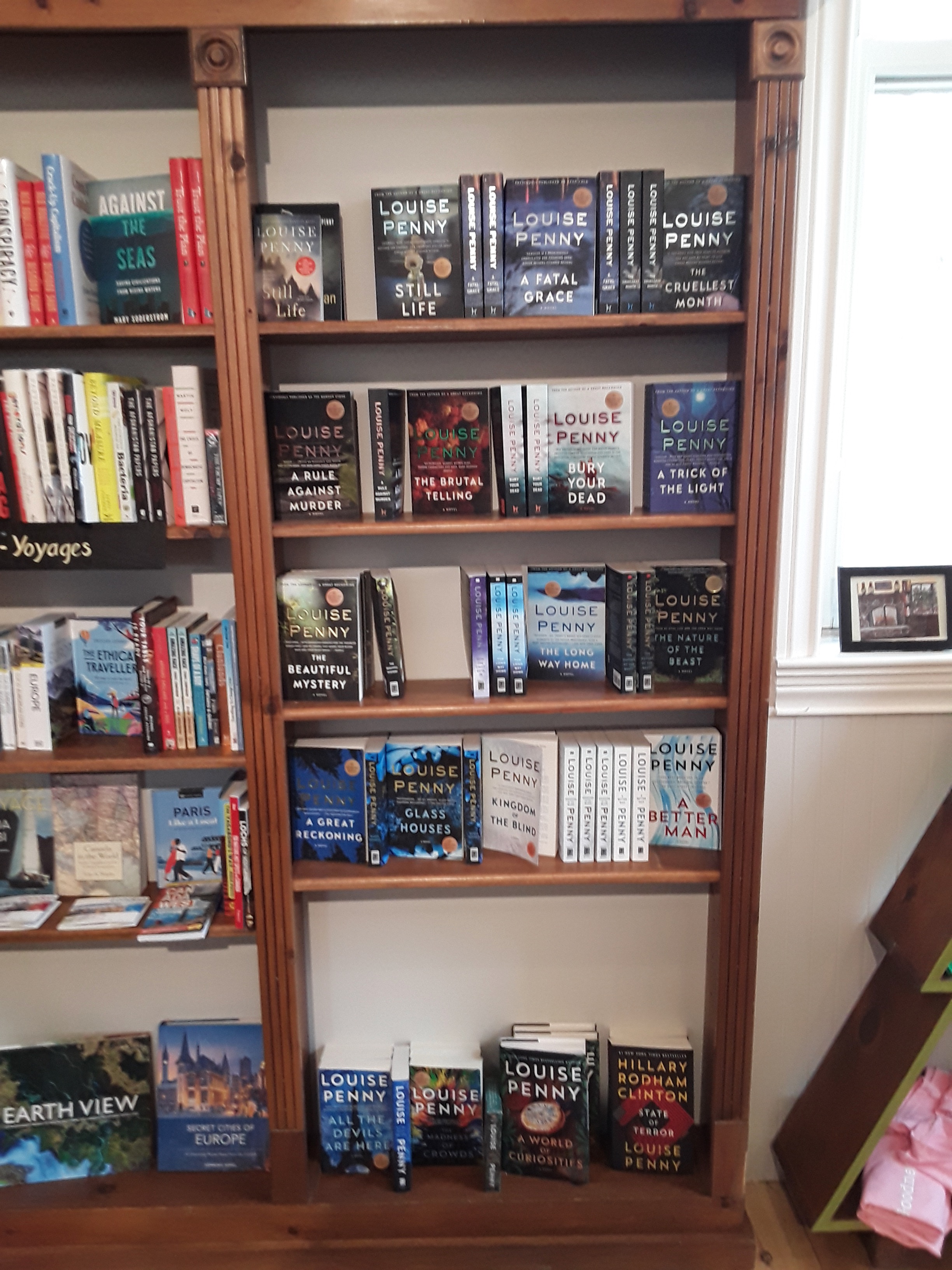
How do you choose what mystery novel to read next?
I depend on my circle of family and friends who also love crime fiction, starting with my mother-in-law, who would very much appreciate it if I could develop more fondness for Donna Leon, Cara Black, and historical mysteries set in the southern United States.
We occasionally love the same book, but more frequently we debate the merits: she dislikes the amount of violence in the feminist PI novels I love; I find the international settings of most of her favourites less compelling to me than Canadian ones (hence this project).
Other brilliant mystery-reading and -writing friends have introduced me to everyone from Peter Robinson and Mick Herron to Alice Walsh and Alexis Koetting (who deserves to be as well known as Robinson).
I’ve been reading mysteries with friends since age 8, sprawled across my childhood friend Heather’s bed and marveling at her bookshelves. The only child of older parents (her mother had hidden in cupboards when the Nazis came to the Dutch farmhouse where a number of city children were being concealed–the germ of my first attempt at a novel), Heather was showered in books.
The complete set of Trixie Belden novels.
Every Nancy Drew book composed by the diligent syndicate authors.
And some other series, including ones I’ve forgotten. Cherry Ames, I think? Nurse and flight attendant mysteries weren’t my favourite, and I imagine they haven’t aged especially well.
A veritable Aladdin’s cave of pre-teen reading material.
A few years later, a friend of my mother’s introduced me to her complete set of Agatha Christie novels, and she also got me started on Ngaio Marsh; a middle-school friend then told me about Dorothy Sayers and Josephine Tey, her grandmother’s favourites. My life-long obsession with mysteries has developed organically, and with support from brilliant book-sharing friends.
So a week ago I picked up a January new release, because the book blurbs included one by novelist Blair Hurley, who taught my Novel Writing I course; she’s an excellent reader and writer, and that was a sufficient endorsement for me. And Sweet Fury is one of my favourite books of the new-ish year.
But today my thoughts are turning more specifically to brilliant friends, because I am reading Nancy K. Miller’s loving and trenchant book by that title, a retrospective of her friendships with three women, including Carolyn Heilbrun, whom she loved and cried with and collaborated with until their deaths . . . and after.
Because our friends don’t leave us, not really.
I had a sundered friendship when I was very pregnant, and it was not my choice to end it.
But I had pushed people away while I dealt with scary pregnancy complications that kept me on bed rest for months. It was too much, then, to half-listen on the phone to my dear ones as they blathered on about being bored at work. I kept checking if I was bleeding again, propped up in bed and writing my dissertation.
Other people’s lives felt trivial, in those days; mine felt urgent and precarious. I was, I’m sure, a terrible friend. Most people forgave me, and we moved on.
She still turns up in my dreams, sometimes, and a book she gave me about women and pianos followed me from home to home for over a decade before I decided that I didn’t want any physical reminders of someone whose conduct I’d found both painful and inexplicable.
Because she refused to talk about it.
Oof. I’m a talker. Must discuss everything.
Back to Nancy K. Miller: what she does in these tender and evocative and fierce essays is consider how women’s friendships are part competition, part love, part admiration, part resentment. It’s a very very good book. I’m taking it to breakfast with me to digest further.
And I think I’d like to write a critical biography of Carolyn Heilbrun/Amanda Cross. This has been percolating for a while, now, as a project. I have two others to complete first, and I don’t know if her family and colleagues would ever want to speak to me about her. But I have things to explore related to Heilbrun, and maternal suicides, so must ponder further.
 The Landscape of Canadian Women's Crime Fiction
Leave a comment