Australian crime writer Jane Harper’s The Dry was one of my favourite reads of the past decade. It has a beguiling premise: a man returns to the small town he’s avoided for decades because of a recent gruesome murder, committed by his childhood best friend. Driven mad by drought and temperature changes and despair, the man has inexplicably killed his family. Aaron Falk is a compelling investigator, but the real drama in this novel is the way that drought due (implicitly) to climate change is bringing devastation to a rural farming community.
Weather and climate are different, of course: that’s one of the most oft-repeated truisms of our time.
But they’re not unconnected. Long droughts, like those that many countries and regions have recently experienced (including southern California–the only one I’ve experienced in person) remind us that water is not always plentifully abundant.
A note on the menu requesting that customers not order water with dinner and consider beer or a soft drink, instead, forces once to consider the oddity that, surely, beer and ginger ale were once, effectively, water? So why an abundance of prepared products and a scarcity of the stuff that comes out of the tap?
When we’re lucky, it comes out of the tap.
I have friends who grew up in countries with periodic electricity brownouts and water shortages. I worry about the future, and whether the next generation will be living on the crumbs of our late 20th century and early 21st century decadence. As a parent, this is all kinds of guilt and shame inducing.
And I’m not the only one who’s worrying, so weather-related disasters and crimes turn up in a broad swath of mystery fiction.
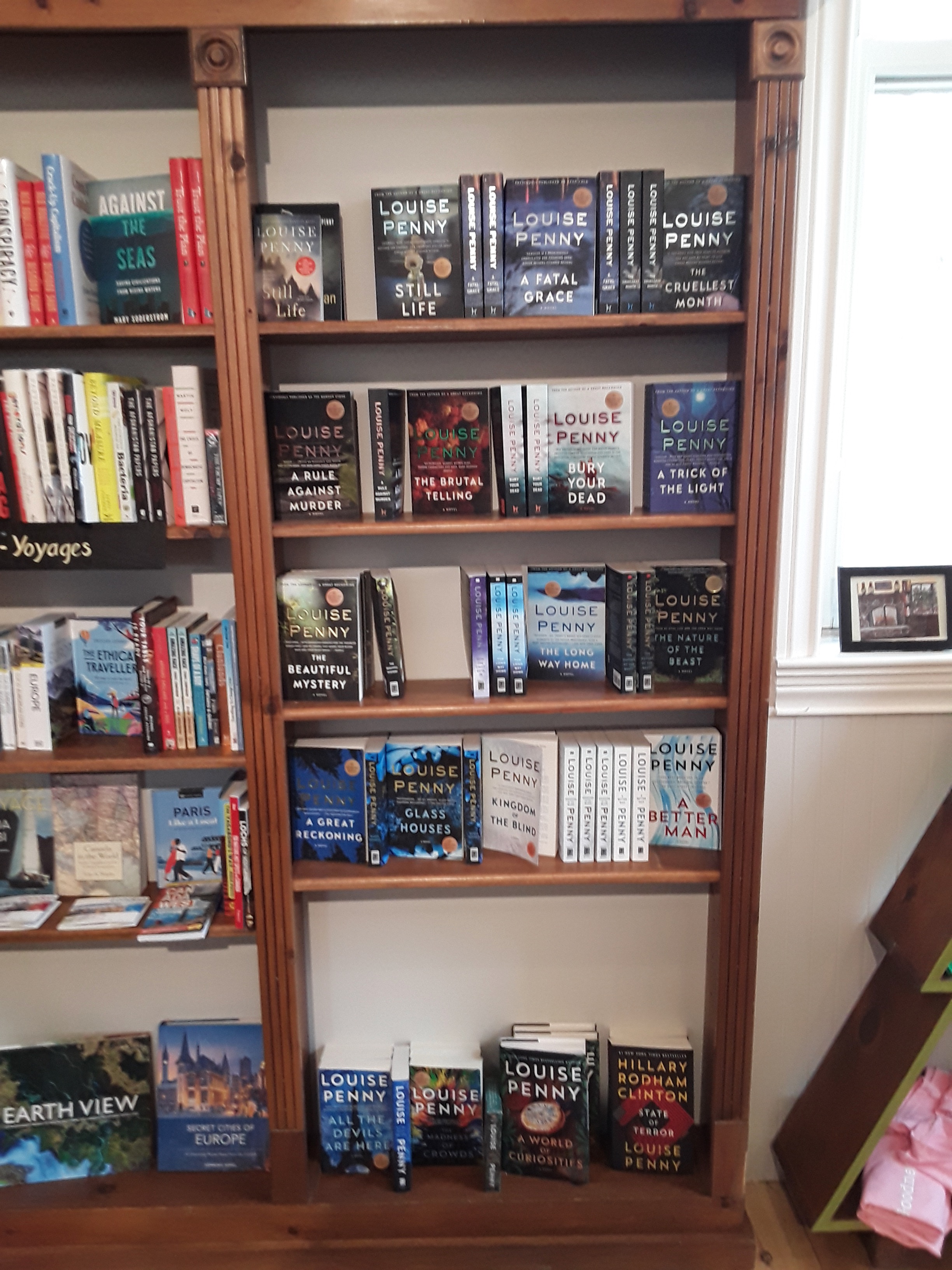
Louise Penny is a bit of an exception here: I can think of a scene in one novel where the river level is rising as the winter snow pack melts too quickly, and the denizens of Three Pines are putting sandbags down. But more frequently, water is something to control in an eco-terrororist plot that Gamache races to thwart.
Other writers are focusing more directly on weather/climate as the culprit (one, of course, propelled by human forces of these past couple of hundred years).
Much of this fiction is labelled “cli-fi” and here, a confession: because I don’t much enjoy speculative fiction, I struggle with Atwood’s Oryx and Crake books, or even Emily St. John Mandel’s Station Eleven. I do better with mystery novels contemplating environmental devastation, like Joan Thomas’s extraordinary Wild Hope. Or Eleanor Catton’s Birnam Wood, which I am currently reading with much delight.
In mystery series, climate and weather have key roles to play in plot, of course. Think of all of the Sue Grafton/Kinsey Millhone novels where the Santa Ana winds are described, or how significant storms and power outages are in some books.
In Canadian crime fiction, weather’s crucial: I’m re-reading Elisabeth de Mariaffi’s The Retreat for a chapter on women-in-the-wilderness novels, an intriguing Canadian variant on women-in-peril novels. Here, there is both an antagonist (usually male) who is haunting the narrator (these are almost always written in the first person). And to get away, she has to be resourceful, cunning, and brave, while battling snow, ice, hail, rain, washed away roads, downed communication systems, etc. In effect, weather functions as a way to cut the characters off from civilization, as in Agatha Christie’s Mousetrap (reminder the inspector skiing in?), or from help: self-sufficiency is all that’s left.
Some reading suggestions, if this appeals:
The Retreat is very good, and it’s an interesting departure for the author; I do wish she’d start setting some crime fiction in Newfoundland, where she now lives, because my NL chapter is skimpy, and this would be a big help.
Gail Anderson-Dargatz is a writer I’ve admired since The Cure for Death by Lightning. In her most recent novel, The Almost Wife and The Almost Widow, she turns to the woman-in-peril thriller with great success. The wilderness setting of the latter is depicted perfectly: place is always conjured up distinctively in her novels.
Canada doesn’t have a woman author who’s precisely parallel to U.S.-based Nevada Barr, and it’s odd: we have wonderful national and provincial parks, and they would make a fabulous setting for a series: “Bloody Banff”: “Terror in Terra Nova.” Writes itself, really. And as we’ve seen lately, the people who live and work in national parks keep an especially close eye on climactic changes and weather disasters.
A last thought–which is more of a question.
I can think of a number of male Indigenous writers who use weather and climate in wilderness/rural settings to great effect in their fiction. Any women writers who are doing this? Katherena Vermette comes to mind, for some of the descriptions in her novels, but I’m wondering about a sustained engagement with wilderness spaces? (And this reminds me that I need to read more of the work by (non-Indigenous) Giles Blunt, who excels at this.)
Reading suggestions welcome!
I’ve been working my way through some promising books by Vicky Delany (Constable Molly Smith series), Barbara Fradkin (the west coast-set series), and a few others, but I would love some more to include here.
 The Landscape of Canadian Women's Crime Fiction
Leave a comment