
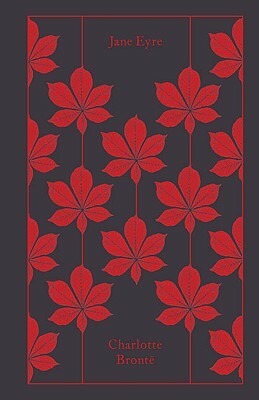
“Reader, I married him,” Jane Eyre tells us. “A quiet wedding we had: he and I, the parson and clerk, were alone present.”
Guests are out of the question, of course. When one’s first attempt at nuptials has been interrupted by a series of events including, but not limited to, the groom’s mad first wife tearing the bride-to-be’s veil (oh, symbolism!) and the timely arrival during the ceremony of a lawyer, who announces the existence of said wife . . . a second effort is likely to be even more subdued than the intimate ceremony planned some months earlier.
Jane Eyre becomes Jane Rochester in a ceremony as private, and likely as despised, as the one that made her own mother a wife.
Sally Cookson directed Jane Eyre in a creative and revelatory adaptation for the National Theatre. She opens with Jane’s birth, which forces us to think about Jane’s mother. We never think about Jane’s mother.
I’ll show segments to students after Reading Week, when we’re talking about how Jane Eyre has inspired countless adaptations and fan-fics. Manga and graphic novels, board games and teen fiction. Contemporary “updates” set in late twentieth century New York, and Korea, and elsewhere.
Jane Eyre is everywhere. One of the places where Jane, that “witch” as Rochester terms her, is lurking is in the contemporary thriller. Specifically, the popular but perhaps waning sub-genre of the domestic thriller, featuring a woman who fears her husband.
A bit of history, here. Jane Eyre begat Rebecca and all of its imitators and successors. But Jane Eyre, while somewhat sui generis, is not sprung whole from Zeus’s head. In fact she has a lot of mothers.
To save time, I’ll just name a few. Ann Radcliffe, for one, and Jane Austen. Yes, ignore the author’s grumpy disparagement of Austen, and note that she named her heroine Jane. Before them, arguably, the 18th century women’s epistolary novel by Frances Burney and others. Going back even further, Samuel Richardson’s Clarissa.
So here’s my argument, and it’s a rather grand one for this early in the day. The English novel, when we date it back to Clarissa, was always already a domestic thriller about whether a suitor could be trusted. And in the hands of female writers, the beautiful, lusted-after virgin no longer sacrifices both her hymen and her life. Instead–thank you Evelina, thank you Jane Eyre–she triumphs, in her own way.
Further to my grand claim, the novel of courtship always risks becoming the novel of seduction and betrayal.
Let’s take Austen’s Sense and Sensibility, her most interesting novel. Not best, I didn’t say best, and I don’t want to hear from the Janeites on this, not even those of you I adore. In that book we learn about a parallel to Marianne in the story, or maybe parable, of the Two Elizas.
Eliza 1, the elder, was raised as the orphaned ward of Colonel Brandon’s unscrupulous father and immoral (in an unclear, vaguely erotic way) older brother. She is manipulated into marriage with the older brother, although Colonel Brandon is the one who really loves her. Then she suffers, divorces, suffers some more, dies.
Eliza 2, the younger, in the care of a woman who turns out to be untrustworthy, was seduced and betrayed by Willoughby. He’s a thorough cad: charming, charismatic, utterly selfish, but with excellent manners. We’ve all fallen for one.
But he also seems to travel in a relatively small circle. He keeps bumping into grumpy Colonel Brandon, a man of so little merit in terms of physical features and age that, in spite of his big military reputation, it’s a bit of a cheat to have my beloved Alan Rickman play him in the Ang Lee adaptation. (I’m having an Alan Rickman Retrospective this week with friends, to cheer myself and others. We will start tonight with S & S.)
Marianne has to learn to mend her ways. Piano-playing and poetry are all well and good for young girls, but courtship requires turning to men who don’t appeal to you one bit but who are devoted, loyal, and sufficiently monied. Here is where we all pause to recognize with horror that, after Marianne sickens and nearly dies, she also settles. Because there are no other good options. Fun love story, Jane Austen.
And her older, wiser sister Elinor, who knew to mostly eschew romance, gets a curate. Lucky Elinor.
My grad school Austen seminar professor, the extraordinary Jane Millgate, worried about the women who married into the clergy. Would their families have enough money to survive on, if there was no additional legacy? Her financial calculations were somewhat byzantine, involving currency rates and market fluctuations, as well as careful assessment of how good a housekeeper each heroine was likely to be. I will confess that prior to Dr. Millgate, it hadn’t occurred to me to rank the wealth of Austen’s heroines, but it’s an interesting exercise. The richest by far is Elizabeth, from P & P, because Darcy is staggeringly wealthy.
The richest in her own right is Emma Woodhouse, who gains far less from marriage than other Austen protagonists. She gets her older, wiser (that again) brother-in-law, who has a fondness for correcting her. One imagines this might be fun in a more louche literary genre, because her spouse George, whom everyone calls Knightley, appears not to be much better off than her rather nouveau riche hypochondriac father. But good news! George is on board with living with her father until he dies. The father, that is. Still, what a fate for Emma and her beloved.
I promise you that I am wending my way to domestic thrillers.
But what if (that great prompter of novels) each of these Austen books was re-imagined as a murder mystery? Who would be the victim, and who would be the murderer? Possibly I should create a board game, for my very dear friend who writes plays that are in intimate dialogue with Jane Austen.
And what if Marianne, in Sense and Sensibility, had “given in” to Willoughby all the way? Then she becomes another Eliza. Imagine Marianne as an unwed mother, and know that Elinor is grimly imagining this, as her sister warbles prettily at the piano for her lover.
That’s why Austen sticks her with an old man. Safety is salvation, moral, social, and religious. All sex within marriage was sanctified, and all sex without was not. Aren’t you glad we aren’t living in Regency times, when men policed women’s sexuality and reproductive capacities? When they claimed access to women’s bodies, money, and children? Oof. I’m finding 2025 is presenting some challenges.
Back to the domestic thriller. Rebecca is Jane Eyre revised, so that Jane is much less interesting (the protagonist doesn’t even have a name) and the dead wife is fascinatingly seductive, if potentially evil.
I know that Wide Sargasso Sea is the much more literary and postcolonial version of this scenario, where the mad wife gets her due, as well as social and historical contextualization. But writers don’t keep revising Rhys. They go for du Maurier, and that’s really interesting.
This has become quite long, so tomorrow, Part II. I will explore the essential intrigue of Jane and Rochester’s S & M relationship (I’m serious; he’s also the original breadcrumber). And I will consider how Jane Eyre launched a thousand contemporary domestic thrillers, including the one I have languishing in a drawer. My Jane ends up placed on involuntary hold, because she is both Jane and Bertha. Now I need to re-read my own novel and figure out what’s there that’s worth keeping.
 The Landscape of Canadian Women's Crime Fiction
Leave a comment