Starting with Sondheim, this morning.
Others may wake, stretch, and repeat soothing words of affirmation.
I wake, shake off the frissons of anxiety about workplace dreams (only recently) and then decide on a Sondheim lyric to get me through the day. I’ve been steeped in Stephen Sondheim’s work since I was about 12 and found in A Little Night Music, of all things, a representation of my feelings about love, loneliness, and fear.
When I took a terrific Playwriting course with Mark Brownell last fall, there was the pleasure of being taught by and alongside what the host of Sondheim Unplugged calls Friends of Steve. I rather like that name because it has intimations of both Friends of Dorothy and Friends of Bill W. (the latter I learned of from an MLA program, way back when, because I’d heard of AA but not of this particular nomenclature). For Reasons, both of these are on my mind: it’s a terrible time in the United States to be trans, or gay, or a woman, or poor, or racialized, or an immigrant (documented or not), or . . . It goes on. And my family’s long history with alcohol, like many, tends to repeat itself; or rhyme, if you will.
So Sondheim.
Yesterday’s mantra was “now you know.” A few days ago, while I was assembling goods and services for tomorrow’s big party, my Mrs. Dalloway fea(s)t, where I am also (almost) all of the servants, it was “putting it together.”
Today, I’ve settled on “Let me entertain you.”
Several friends have recently read and wished to discuss the co-authored Canadian mystery novel Bury the Lead, which is a fun pun of a title; so good, in fact, that it’s been used multiple times, with variants on ‘bury the lede/lead’.
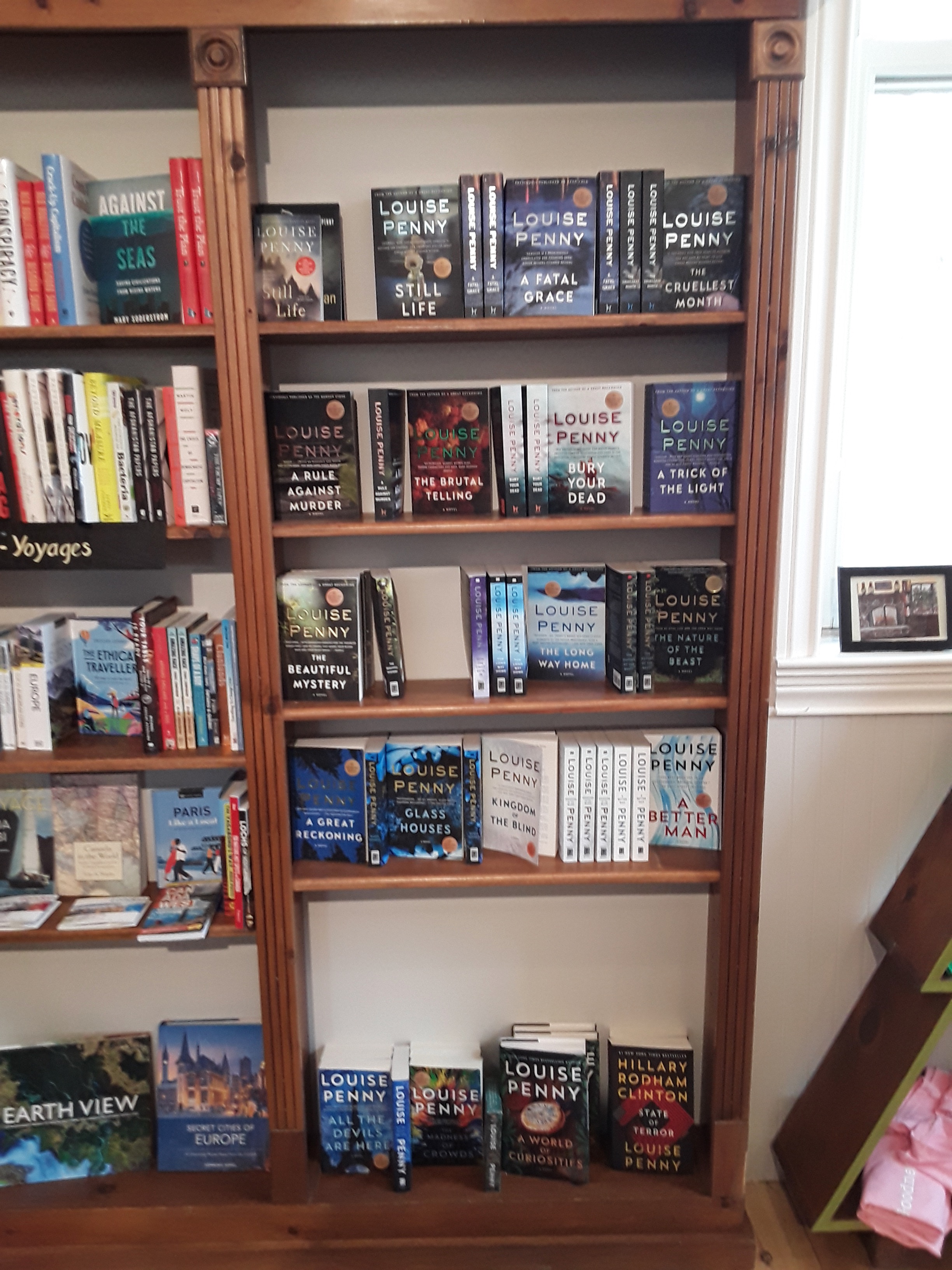
But there is nothing new under the sun, even murder, and thus mystery titles that are both original and distinctive are a challenge. (Have you noticed that Louise Penny’s titles are sometimes interchangeable? I have a great deal of difficulty recalling her wonderfully unique plots by the books’ titles, because of this. Examples: The Cruellest Month; A Trick of the Light; The Brutal Telling.And it’s not helping that we’re now into Grey Wolf/Black Wolf, as a twinned set.)
I like but don’t love Kate Hilton and Elizabeth Renzetti’s debut effort, and I do look forward to seeing where this series will go.
The TL;DR: a city journalist, smarting from her divorce and the breakup of her family, moves to a small town with a storied theatre history. She becomes embroiled after an aging and problematic actor she interviews dies, dramatically, on stage.
Sometimes, then, “dying on stage” is not a metaphor.
Here’s what I liked: Cat Conway is an appealing protagonist and her plight is engaging, so the stakes are relatively high. The community of “extras”–all of the people Cat meets, talks to, suspects of murder–is nicely drawn. And the locale is depicted with careful attention to detail.
I attended a Zoom presentation by B.C. mystery writer Amber Cowie the other day on place, and she had us do some very fun exercises to sharpen our place-making skills. Hilton and Renzetti nail this aspect, and the social and class divides they depict in this cottage country Ontario community will be familiar to many readers.
Is it fair to say, then, that I didn’t find the mystery component especially compelling–in part because so much here is familiar? I love Renzetti’s political writing, and some of her sensibility has been bestowed on Cat, but not all of it: I think sharpening her up to make her less likeable and vulnerable would improve the series for me. Because I’m having trouble believing that a tough big-city journalist would be experiencing some of Cat’s challenges with relatively small challenges.
Let me turn to an established series set in a theatrical milieu, and then I’ll share suggestions for a handful of series novels with theatre (or film) contexts that are used as one-offs.
Alexis Koetting is a Newfoundland-based actor whose writing was introduced to me by a friend who adores her and has worked with her on a number of shows. But her series is set back in Ontario, where she grew up, and the protagonist is an actor at Niagara-on-the-Lake’s Shaw Festival.
Love Niagara-on-the-Lake. Love Shaw. This is perfect.
Koetting’s protagonist, Bella James, is a successful TV actor making a transition to theatre, and the drama scenes are, unsurprisingly, remarkably well drawn, with lots of insider details.
But these are also good mysteries: carefully plotted and with surprising twists.
And there’s a deeply felt commitment to people who are marginalized in these novels, and especially women who have been the victims of violence and whose perpetrators have–until Bella’s intervention–evaded consequences. These are not thrillers and they’re not cozies: they’re amateur investigator books with an unusually intense sense of place and community, rooted in theatre. I’ve really enjoyed them and I’m lobbying for more novels.
Penny’s work, I should note, incorporates amateur theatricals in the novel I’m re-reading (slowly, because I find it so disquieting): The Nature of the Beast. Gabri is starring in a community production of a work penned by a mysterious author; Gamache suspects the author may be a notorious serial killer he locked up. Talk about problematic.
And that takes me, very briefly, to a round-up of some good novels set in the world of film acting, rather than theatre:
Gail Bowen introduced film actors into her Joanne Kilbourn series several novels ago, and this has generally been a good thing, with some poignant depictions of abuse and exploitation–as well as creativity–in the world of film acting.
A Broadway play inspired by a painting by Desmond Love, father of Sally Love (Jo’s childhood friend) ends up connecting the playwright to Jo’s family in some rather tenuous yet intense ways. And when the play is adapted to film, Zach, in his capacity as mayor of Regina, helps steer it to the local film production industry that he’s been re-invigorating through tax incentives. The film actors and a subsequent TV production, based on Joanne’s own childhood and the revelation of her biological parentage, takes us through some additional books.
Then there’s the American novel I’m currently reading with some bemusement. It’s fast-paced and deeply immersed in the world of F. Scott Fitzgerald. The premise is that a new adaptation of Tender is the Night aims to give back feminist agency to Nicole Diver.
To readers of the novel: Nicole Diver has feminist agency? Yes. Agreed.
I’ve ordered a copy so I can check my memories of a book I recall tossing against a wall in frustration back in the early 90s, during an era when women were telling our own stories of sexual abuse. Reading about Fitzgerald’s appalling and bizarre fantasy of an incest survivor was not to my taste.
An Americanist grad TA once condescendingly explained to a group of young women at a party that all of the violence in the novel was metaphorical and symbolic.
And then we tore him to pieces, in the spirit of the Erinyes.
Kidding.
But I’m older, and I suspect I’ll review the novel with fresh eyes and more forgiveness.
And that takes me to the book’s title: Sweet Fury, which is why the Furies are on my mind as I glance over at the cover.
I am really liking Sash Bischoff‘s first novel, with its portrait of a too-involved and rather smug male psychiatrist treating an “America’s Sweetheart” actor as she tackles the role of a re-imagined Nicole.
Like Koetting, Bischoff comes from the acting world she describes, and it shows.
I do wish the book wasn’t billed as a feminist revenge tale, because . . . that seems to give the plot away more than the opening chapters of the novel do, and it might be good to keep the Erinyes as a surprise.
 The Landscape of Canadian Women's Crime Fiction
Leave a comment