This will be my fourth and, for now, final foray into the academic mystery novel, and here I will be considering Donna Tartt’s unexpected blockbuster The Secret History; an odd curiosity found in a second-hand book store, Carol Clemeau’s The Ariadne Clue; the recent fiction of Alex Michaelides, including The Maidens; and to end on an unexpected note, Alice Munro’s short story “Silence,” the final in her “triptych” about classicist Juliet whose life veers off in unexpected directions from the first story, “Chance,” where she is a young grad student travelling by train to Vancouver to take up a position at a private girls’ school, through “Soon,” which sees her as a young mother visiting her own dying mother back in Ontario (a classic Munro motif), to the concluding “Silence,” where Juliet is estranged–it would appear permanently–from her daughter, the unforthcoming 21-year-old Penelope, who has removed herself from her mother’s life.
That was my attempt at writing a grab-bag of a Victorian sentence, with many clauses and topics. The rest of this post, a baggy monster with some jump scares, will be similar. I’m re-reading A.S. Byatt’s Possession, which is ever better than I remembered, and it’s doing things to my prose style.
Let’s start with The Secret History, since I intend to dispense with it briskly. If you want to know more, GoodReads’s delighted legions of fans will wax rapturous for you. There are reviews, interviews, a handful of half-decent critical articles. It’s a large book, so all of this will keep you busy for some time. When you surface for air, you can plunge back into Tartt’s prose in equally long or even longer novels such as The Goldfinch, intermittently excellent and deeply exasperating.
I read The Secret History shortly after it came out, while completing a minor in Classics at U of T, alongside my English Specialist. Reading Euripides and Sophocles in translation frustrated me, but I was too busy/lazy/intimidated to learn Greek. Instead, over the decades, I would occasionally remember a word from Eric Csapo’s Greek Tragedy lectures. Amphora! Caryatid! Supplicate!
I promise you this will meander soon to books.
A number of months ago, inspired by the example of The New Yorker’s redoubtable Mary Norris, I decided to venture into learning how to write the Greek alphabet. I have made it far enough along to be clenching my teeth in frustration as I attempt to learn the contractions. If you know, you know, and otherwise don’t worry about it. Just trust me that it’s a combination of tedious and difficult. In short, I have made slow and halting progress, but some progress. There is a pleasure in revisiting old friendships and reflecting upon past “foolishness”, a Munrovian word, so perhaps I’ll turn to Munro first and then last.
With thanks to Robert McGill at U of T for the wonderfully reflective piece about his relationship to Munro, as both critic and creative writer, published in the Literary Review of Canada. Bob, if I may, is an author who rewards careful reading. I discovered this decades ago when I encountered his first novel, The Mysteries, and invited him to speak to my Intro to Canadian Studies course. Students were thrilled to meet a real writer who was close-ish to their ages, so fun was had. Most recently, we were both on a panel for ACQL. To my shame (Munro again), I don’t recall what I was discussing, but Bob was talking about Munro’s discomfiting story “Eskimo.”
Oh. I do recall, but it took a moment. It was Dr. Edith Vane and the Hares of Crawley Hall. I was processing (not a Munro word or concept, as we have learned) a difficult experience by giving a paper about Suzette Mayr, and the portrayal of toxic academia in the entertaining YouTube series about lesbian vampires, a contemporary updating of Carmilla. As a character trills in Mayr’s novel, research, me-search. A close friend is currently teaching UVic’s terrific course on vampires in lit and film. I lobbied hard for the inclusion of Carmilla and the opportunity to do a guest talk, but Andrew Murray’s reading list was overflowing. Must try again next time he gets to teach it. The course is popular, and it’s been nice to see the media interest.
But Munro. See how much I don’t want to talk about “Silence”? Because we now know that it was published in the New Yorker, where much of her work appeared only to be trimmed and re-shaped for later books, a couple of years into her estrangement from her youngest daughter. An estrangement prompted not by some obdurateness in the daughter’s nature, as Juliet in “Silence” proposes about Penelope’s apparently baffling disappearance from her life, but by very specific and painful family circumstances.
A minor classical tragedy. Mother and daughter estranged by the conduct of an abusive man, the mother unable to see her daughter’s perspective or choose her over her life partner. Unbearable. Really, Alice Munro? You spent decades probing the human heart and soul, and couldn’t figure out a basic truth of parental obligation? Moving on, because I’m furious, and when I meander into apostrophe it’s time to change the subject. So that’s my Canadian women’s classical mystery. Let’s put a few novels alongside Munro, to make this manageable for all of us.
Alex Michaelides sells a lot of books. Donna Tartt sells a lot of books. However, there are cheap tricks and lovely tricks (oh shush, Alice Munro) in their work. I’m particularly unhappy with Michaelides because his last book was not good, and I think his depictions of women are bizarre. They seem like variants of Nicole Diver or, to take a real-life example, Sylvia Plath. Doomed and tragic, brilliant and beautiful, likely to ensnare men in disasters and scandal. But as they say in Chicago, “he had it coming”: the male characters are no prize either.
I don’t mind novels with unlikable characters, but I do expect them to resemble real people, and that’s where Michaelides runs into trouble in my view. These are cardboard cutouts (archetypes, to flatter the author) and the women characters are poorly drawn. He’s made millions and there will be film adaptations, so mine is clearly a minority and grudging assessment. The classical schtick in his books is too transparent, though, and the same is true of Tartt to an extent.
In The Maidens there’s a group of wispy girls, the titular maidens, trailing along after a charismatic American Cambridge classics professor. A grieving therapist with various challenges comes to the aid of her niece, who is convinced that her friend has been murdered by said professor. There are ancient rites, Persephone tributes, etc. Having somewhat enjoyed his The Silent Patient, and having been engaged by this novel’s setting and premise, I was let down by the execution. Nor was I persuaded by the author’s grasp of Greek Tragedy, which is rather vital to the book.
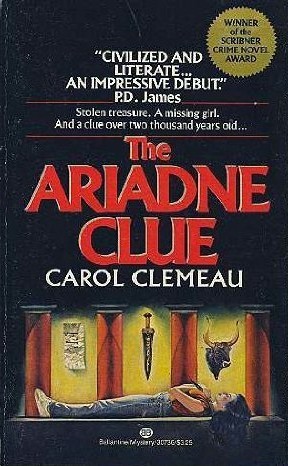
And there’s also Carol Clemeau’s slimmer volume, The Ariadne Clue. I came across it in a little second-hand bookstore in Victoria where the shelves bulge with unusual mystery novels, dating from when the shop shared premises with the sadly defunct mystery bookstore. I’ve sent the novel on to my personal classics professor and am awaiting his verdict. I found it slight but well-constructed with a plot about an exhibit at the campus museum, a theft of a gold Agamemnon mask, and the disappearance of a young grad student whose prof decides to investigate. Antonia Nielson is an appealing and believable character, and I’m sorry Clemeau didn’t write a series after this early 80s foray into mystery fiction.
Back to Munro, briefly. I’m still working on ideas for bringing together CanLit scholars and people who care about violence against women, because of lived and/or professional experience. We need to talk about what it means that Munro blithely continued collecting accolades through years of estrangement from her daughter. That Munro’s partner pled guilty and was sentenced for his conduct decades earlier. That people like Munro’s publisher and biographer knew, and kept silent.
It’s going to be a challenging conversation and in my initial exchanges with scholars, I’ve had the sense that none of us are quite ready yet. But soon. No more silence. Soon.
 The Landscape of Canadian Women's Crime Fiction
Leave a comment