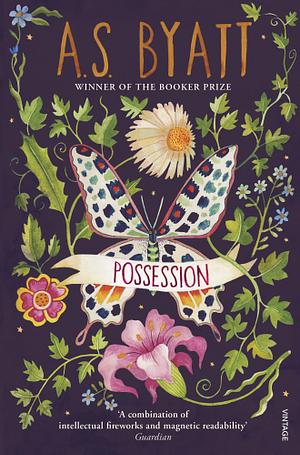
Have you read A.S. Byatt’s Possession? It’s a brilliant book, although I find the most highly praised portions–the author’s careful recreation of Victorian poetry in two voices–far less engaging than the academic caper and intrigue. It’s extraordinary that Byatt can create poetry, in quasi-Browning/Tennyson and Rossetti/Barrett Browning styles, so effectively. But there is already more Browning and so much more Tennyson than I will ever get through, so why would I want pastiche? That’s just me, though.
There’s a more detailed and thoughtful re-reading of the novel here, for the uninitiated. It won the Booker in 1990, which was 35 years ago, oof. Perhaps that’s why it’s on my mind. I’ve been writing about 1988-95 for a fun and unpublishable project, and I’ve been immersed in the music, food, and culture of the era.
Back to my point. Our hero is a hapless, rather unprepossessing, and underemployed academic, Roland Michell. Toiling fruitlessly as a research assistant in the London Library, he discovers what appear to be letters composed by an eminent Victorian poet, Randolph Henry Ash. And he steals them.
To discern to whom they were addressed, however, he needs the assistance of Dr. Maud Bailey. She’s far more attractive, charismatic, and successful, a scholar on the poetess Christabel LaMotte who is also her distant ancestor. Get it? Motte and Bailey? If you don’t (just as I didn’t, c. 1990), not to worry. But there is a lot of this sort of thing, because Byatt is as brainy as Murdoch but much funnier.
Many things happen. There is extensive discussion of the poetry, and of what turn out to be love letters that reveal a previously-unknown relationship between the pair of writers. The letters are restored to the rightful heir, and instead of being pilloried for purloining them in the first place, Roland now has some hope of a successful academic career.
And of love, of course, and this is the part of the book that gave me conniptions as an undergraduate. Initially Roland is living in a dismal flat with the dull Val, and to my mind (I’m unwavering in this), that is pretty much where he belongs. Not with the luminous Maud. My Maud would take many lovers and not settle, but clearly Byatt felt differently.
The novel’s villain is an acquisitive American who wants to snatch the letters for his own research library/archive. He’s quite fun, Mortimer Cropper. Practically twirls his moustache and drools over the manuscripts.
I read Possession for fun and then re-read it, more thoughtfully, in two academic courses: British Fiction Since 1960 with Nicola Nixon, who was working on mystery and detective fiction and taught it as such (which was terrifically helpful); and a course in Women Writers, where it was paired with Byatt’s Still Life. I fell hard for Byatt, after initially finding her work less accessible than the fiction of Margaret Drabble, her sister, who had been a favourite of mine since high school.
Much actual work to do today.
In Part II of this post I will do a survey of academic mystery novels, to demonstrate the dominance of quarrelsome and murderous English departments. In Part III I will turn to Classics Departments and the pre- and post-Donna Tartt works, in which classical mythology and Bacchanalian rites are adapted to contemporary and macabre needs.
And then there’s Gail Bowen, and there’s Nora Kelly. My Canadian women writers of academic mystery fiction do not nestle their heroines into English departments. Bowen’s protagonist is in political science, while Kelly’s Gillian Adams is a historian. She’s effectively English adjacent, since we do have substantial overlap, especially when it comes to the medievalists and others who need to learn languages and study manuscripts. But the broader point I’m making does not, in fact, hold for my own book project.
 The Landscape of Canadian Women's Crime Fiction
Leave a comment