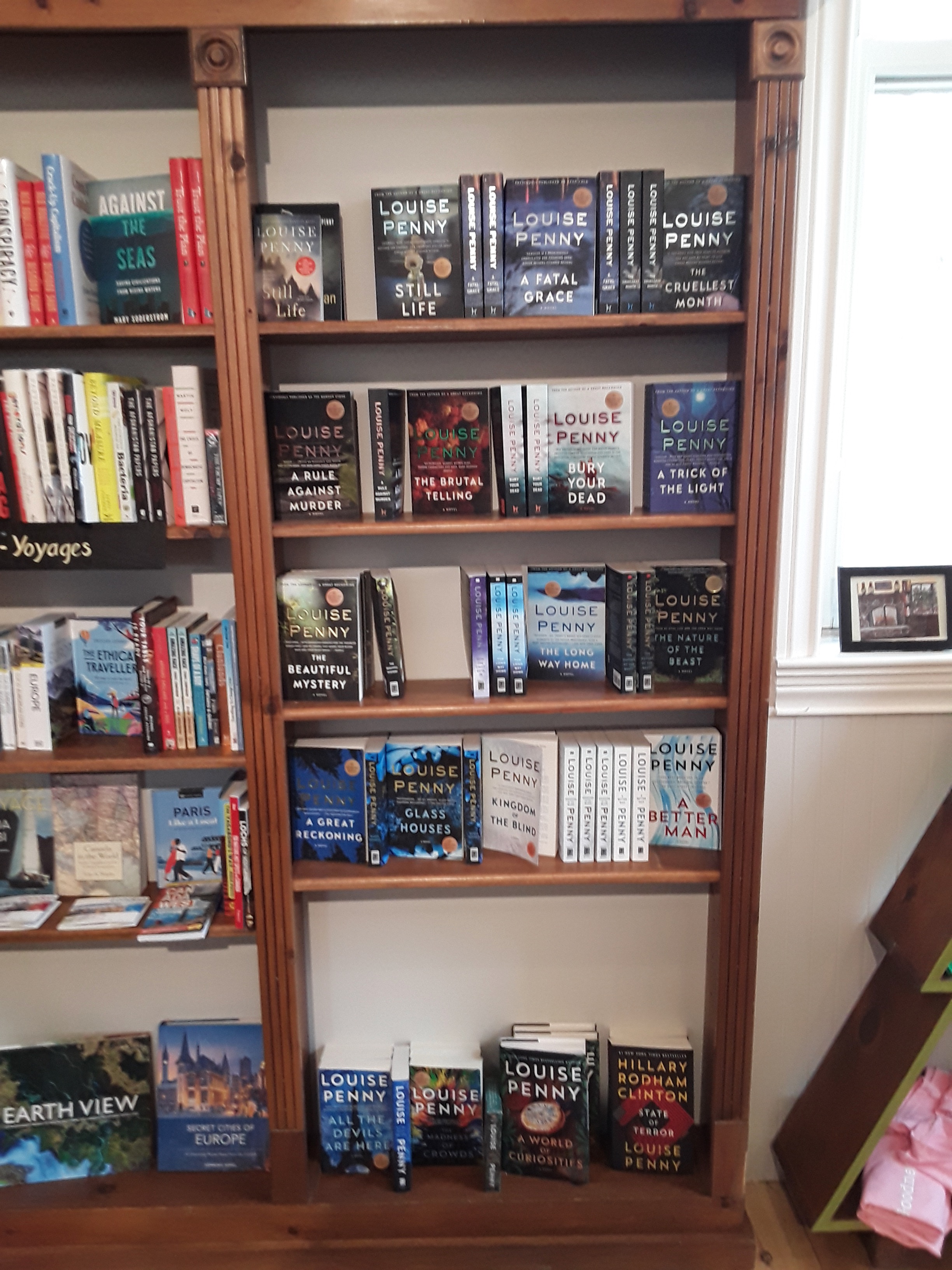
Beth Kalikoff, writing in 2006, called attention to the plethora of mystery novels, most of which were enduring series, that incorporated food directly into the murder plot and not always because the victim was poisoned. As she described, while noting that only limited critical attention had been paid to date to the phenomenon, mystery novels by Nancy Pickard, Diane Mott Davidson, Tamar Myers, Joanne Fluke and many more highlighted the relationship between femininity, feminism, the kitchen, and violence in fascinating ways.
My sense is that two things have happened over the past two decades: some of these series have ended (but been replaced by new ones, often featuring food-adjacent locales and thematic preoccupations, such as tea rooms and cozy bookstores with a coffee stand) and others have soldiered on with increasingly pedestrian output. For a time, my child (who is not, to my everlasting regret, a big mystery fan) was very taken with the fiction of Laura Childs. I was baffled. But E. explained that like the fairy flower and other series they had been reading only a few years earlier, age 11 was just about ideal for bloodless murder mysteries with recipes for tea parties. Nancy Drew and Trixie Belden, E. felt, were jejune.
(Not their word. But close.)
My challenge with Laura Childs et al. is that the mystery plots are so subordinated to setting and cheery conversation among decades-old friends. These are sweet books, in both senses, but they are not meaty.
And here we see the centrality of food imagery for talking about food mysteries.
Food is, of course, most closely associated with the cozy, and this is the gendered feminine form of the mystery. The protagonists run flower shops or bakeries; they juggle school drop-offs and PTA meetings with investigating the disappearance of their next-door-neighbour.
Some of them aren’t bad–I especially likely Ayelat Waldman’s grittier take on this domestic cozy–but they aren’t quite my thing. And they morph, surprisingly easily, into the romantic suspense novel and, more recently, the massive success that is the Hallmark movie, where food themes and settings abound.
But let’s start with a sui generis, or perhaps genre-creating contribution, by the inexhaustible Nora Ephron. Before she was a filmmaker she was a stay-at-home mother and former magazine writer in her late 30s. Her second marriage imploded when she discovered that her husband (who was either Woodward or Bernstein–yeah, it must have been Bernstein, because this is a very Jewish novel) was having an affair. With someone smart and tall, even more annoyingly.
Since Ephron was pregnant with their second child, the timing for exiting a marriage with grace was rather tricky. But she did it and then–thank heavens–wrote the hilarious Heartburn which I will, on the basis of no evidence, dub the progenitor of the food-romance-mystery novel. And I’ll do some research later.
Heartburn appeared in 1983, and hubby number 2 was not happy about how he and his paramour were portrayed; he even sued, to ensure he could have some influence over how Jack Nicholson portrayed him in the film version. (My two cents: once you know you’ve been imagined as a character played by Jack Nicholson, there’s not much point quibbling at the margins about nuances of character building; you’re doomed, bud. He’s playing you as a selfish lech who is also smart and probably deeply anxious._
Since that time, over more than four decades now of food/family/mystery/romance writing, women have dominated in this genre. Or genres, because we see a distinct bifurcation between the mystery and the romance.
Except when we don’t, and this is where my thinking is a bit challenged: how is it that a Christmas party catered at the last minute by a big-city gal who’s trying to save her family’s small business after her mother’s heart attack can end with either a kiss under the mistletoe or a knife through the ribs?
And often, until that climactic moment, the genre is not quite clearly defined.
Must contemplate this some more.
But feminism. Because there’s an intriguing distance in power and privilege between being a wife in the kitchen cooking for her husband’s colleagues and being a paid caterer puffing up the same canapes and hors d’oeuvres.
Take the example of one of my favourite writers in the food cozy genre, Diane Mott Davidson, b. 1949. (And I have just learned that she lived across the residence hall from Hillary Clinton, so the mind boggles. Wow, Wellesley.)
According to her Wikipedia page, she began her culinary mystery writing when she won a short-story Anthony Award for her 1993 “Cold Turkey.” Must look that up.
Her long-running Goldy Schulz series is about a Colorado caterer and former battered wife; her first husband, a doctor, is the father of her son. And that’s gets messy, more than once in the novels. He’s an appalling character, but the fact that Goldy and the doctor’s second wife, Marla, become best friends is quite fun. Marla is rich in her own right and, unlike Goldy, approaches their shared former spouse from a position of significant power, which also helps embolden Goldy, whose post-divorce life is financially and personally challenging.
Just writing about these characters makes me feel happy, even though I will confess that these novels are very slight. The mysteries are easily seen through from about page 30, but I keep reading, anyway, for the banter and the recipes. And I’ve cooked from the recipes and can vouch for them, but be careful about oven temperature: here at sea level things bake quite differently than at Goldy’s altitude.
There are apparently some not-great TV adaptations.
But the more recent adaptations seem to have stronger reviews and they’re Hallmark fan favourites, so there’s that.
But back to Heartburn: Ephron, of course, also incorporates recipes into her novel, so I’m curious about what writers before her did the same?
And also I’m a bit sorry that Heartburn doesn’t end with the (fictional of course) demise of the cheating spouse, carried off by over-rich chocolate mousse, or something of that sort. But it’s a fabulous book, a brilliant movie, and the re-launch of Nora Ephron’s professional life, which enabled her to become, you know, Nora Ephron. All things to cheer.
Next post, incidentally, turns to food in the much darker genres of the serial killer and forensic anthropologist fiction of bestselling writers Patricia Cornwell and Canada-U.S. writer Kathy Reichs. I have a more ambivalent relationship to these much grittier and graphic books, and I think food is serving a rather different function here.
But try this cookbook! Am in search of it.
 The Landscape of Canadian Women's Crime Fiction
Leave a comment