I was intending to write on Alice Munro’s “Vandals” (redux) this morning, but it’s the first teaching day of the term and so my mind has turned, inevitably, to final proofreading of course outlines. At the moment I have a creative writing course, Introduction to Creative Nonfiction, taught entirely online. Contemplating how to make this as engaging for class members as my CNF courses have been for me, as a student has occupied much of my fall.
One of my decisions was to focus almost entirely on contemporary examples, and not spend weeks wading through Montaigne on our way to an understanding of the lyric essay.
Other pedagogical choices are defensible; a grounding in the long history of the essay, from classical to modern, can be very helpful. But my college students are almost always aspiring writers, and Camosun has a terrific new Creative Writing Certificate program for them. A focus on the now, including how to locate publication and prize opportunities, seemed preferable.
Rebecca Godfrey is one of the authors I’ve included for students to read. She is the daughter of a Victoria-area retired writer, Ellen Godfrey, who does a tremendous amount of good working on social/political causes. I read Ellen Godfrey‘s mystery fiction, set in Toronto, during the late 1980s and early 1990s. Then I read Rebecca Godfrey’s stunning true crime book about one of Victoria, BC’s most talked-about murders decades later, not realizing that they were mother and daughter. For CanLit folks, Rebecca Godfrey’s father is, of course, the late Dave Godfrey.
Let’s start chronologically, with my holiday re-read of Ellen Godfrey’s second of the Jane Tregar mystery novels, and probably my favourite of hers: Georgia Disappeared. I’m reminded that she wrote a true crime book that I read years ago, By Reason of Doubt, an Edgar-winning account of the murder of Betty Belshaw. Since my intent was to contrast the mother’s mystery fiction and the daughter’s true crime writing, my approach falls apart a bit there, but oh well.
Georgia Disappeared has the kind of amateur female sleuth who became the sine qua non of feminist mystery fiction. A professional woman with a strong sense of independence, and some ambivalence about her romantic life, which can be attributed to the fact that the men of her generation haven’t caught up to the strides made by second-wave feminist women. Jane Tregar works as a corporate headhunter, and in this volume she takes on the fraught task of managing a stroppy team of software developers, preparing for a big launch in the wake of the disappearance of the titular Georgia.
Since Godfrey’s mystery was published in 1993, I hope it’s okay to reveal that this turns out to be a sordid domestic murder. Not one occasioned by corporate espionage, backstabbing, or any of the other potential motives that Jane pursues. It’s intimate partner violence. Femicide.
Jane’s investigation, sparked by a friend’s request that she find out what happened to their mutual acquaintance, takes her perilously close to reproducing Georgia’s terrible fate. In what is my only real caveat about a well-paced and well-written mystery, Jane is dismayingly susceptible to surface-level charm by charismatic men of means. Romantic meals and horseback riding with prime suspects seems . . . unwise.
But it’s a very good book, and despite the more than three decades that have passed since its publication, it holds up well. Godfrey was drawing on personal knowledge of the industry she depicts, and part of the pleasure of this book is how astutely she portrays programming geniuses. There’s a whiff of Steve Jobs here.
Rebecca Godfrey died much too young, in 2022. At the time I tried to interest the local paper in a tribute article, but because she’d lived in New York for most of her adult life, she didn’t fit the definition of “local” that is required. More recently she’s been in the news again. Her second novel, incomplete at the time of her death, has been finished by her friend and CNF author Leslie Jamison, whose work I admire. Godfrey’s first novel, The Torn Skirt, is terrific. It’s a sort-of YA book because of the age of the characters, and it’s intense and deeply moving.
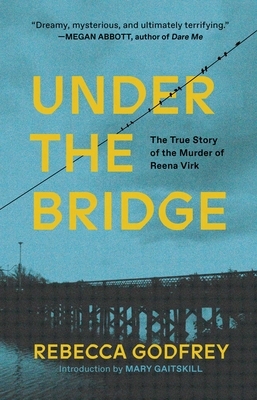
And so is Under the Bridge, her foray into true crime, an account of the murder of Reena Virk by fellow teenagers late one night in a Victoria suburb. A group consisting primarily of troubled adolescent girls instigated an assault that ended with Virk being killed, by Kelly Ellard and Warren Glowatski. The causes of the conflict–gossip, sexual jealousy, boredom–all seemed trivial. Virk was a racialized young woman dealing with complex family issues, in a mostly-white (then and now) bucolic location with a surprising amount of vicious crime.
Just before Godfrey’s death from cancer, a television adaptation was announced, her account of the crime and its aftermath having been published 20 years ago. That produced a bit of a stir in Victoria, including interviews with Reena Virk’s surviving family members. But because the limited series isn’t readily available to watch here, there’s been more American coverage of whether the adaptation is exploitative, or sensitively revealing about the secret lives of teenage girls. It’s a Big Deal, with A-list actors. I haven’t been able to access it yet, so I’ll just note that given how carefully researched Godfrey’s book project was, there is lots of material to work with. I hope the adaptation is attuned to the complexities of the tragic event.
This is an instance where I am torn between feelings of revulsion and empathy. Everyone involved was so very young. Several of the girls had spent time in or were currently living in foster and group homes due to family issues, as Virk herself was. After serving his prison sentence, Warren Glowatski reconciled with Virk’s family through a restorative justice program.
His co-accused, though, that’s a fascinating story. Kelly Ellard served quite a long sentence, for someone who was only 15 at the time of the assault and murder. She was tried as an adult (three times!) and eventually convicted in 2005, the same year that Under the Bridge was published. Because criminal proceedings were ongoing while Godfrey was researching the book, accessing Ellard’s perspective, and understanding her motivation and her culpability, was one of Godfrey’s most challenging tasks. For me, Ellard remains relatively opaque in the book and in all media accounts. She wasn’t from the same hard-knock circumstances as most of the participants in this obscene crime. She’s still under the supervision of the criminal justice system, all these years later.
Interesting, perhaps, to contrast her circumstances with those of Karla Homolka. I need to write about Elisabeth de Mariaffi’s excellent novel, which is partly based on the terror that Paul Bernardo’s series of sexual assaults inflicted on Toronto-area women. So I’ll get back to Homolka, whose lack of real punishment haunts me. In true crime, the idea of the monster is common, the perpetrator whose crimes are so heinous that their claim to humanity is in question. We all feel safer when we can easily distinguish between ourselves and our monsters. But what Godfrey’s book does so brilliantly (albeit with some formidable challenges, in the case of Ellard) is point out how we create our own terrors.
If you haven’t read Under the Bridge and you’re not a true crime reader, you might consider reading it anyway. It’s an extraordinary book, and Godfrey effectively embeds herself in Victoria’s youth culture to understand the young women that she’s writing about. I hope the adaptation does justice to her insight and empathy. And I hope that the strenuous activism of Reena Virk’s parents, which changed the national conversation about bullying and racism, is still heeded.
 The Landscape of Canadian Women's Crime Fiction
Leave a comment