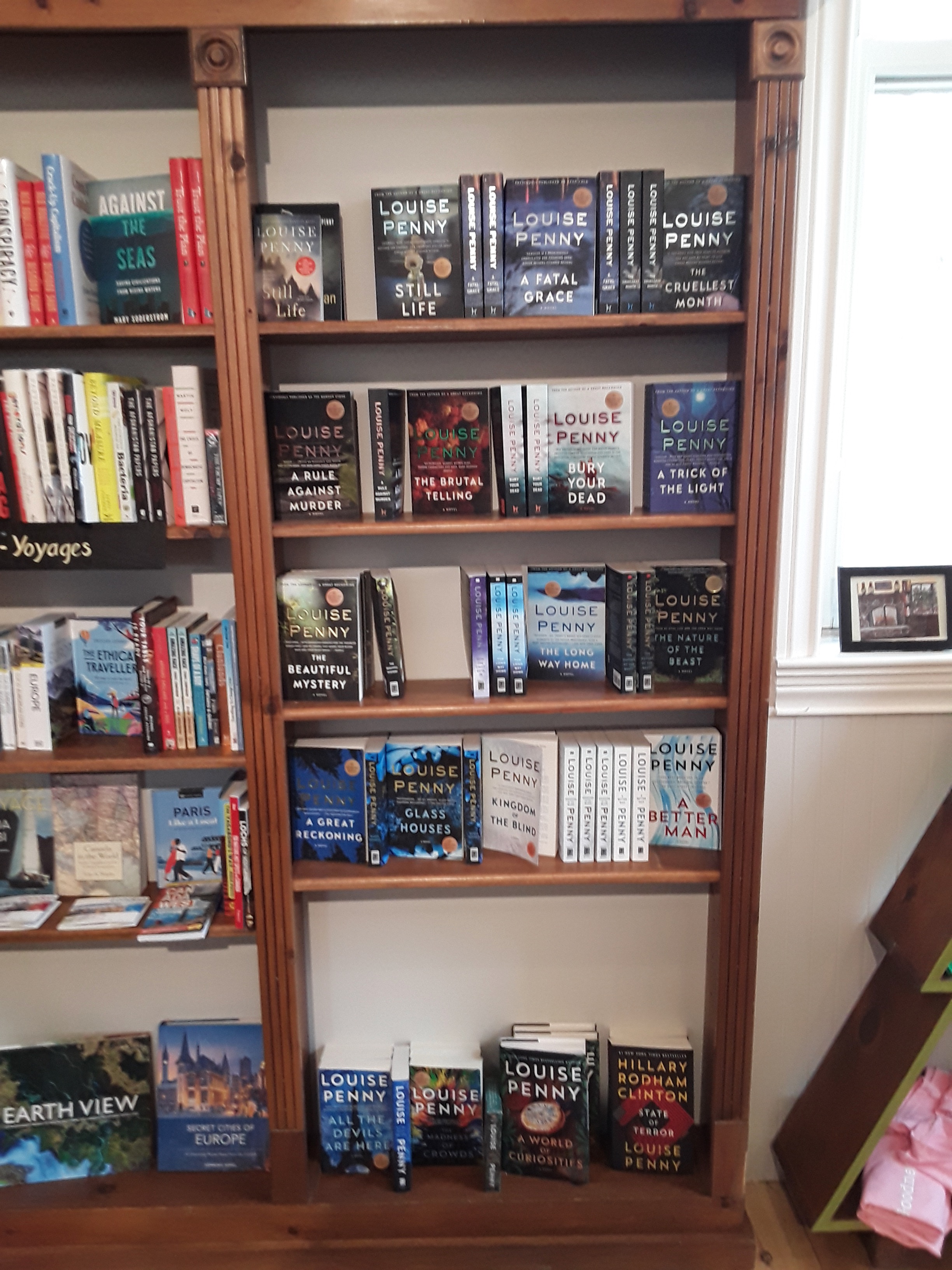
The premise of my book project is that there is something distinctive about the way that Canadian women writers craft crime fiction, even though they do so in contrasting genres of the cozy (domestic setting; food and friends; no gore), the thriller (domestic or public setting; more enemies than friends; potential gore), and the police procedural (ditto).
But this assumption is informed by my own literary mal/formation as a feminist scholar in multiple anti-feminist contexts. Or at least contexts where feminist critical approaches were not deemed relevant. (I’m recalling a graduate Yeats seminar where I became the champion of the poetry of Maud Gonne, out of impatience with the veneration of the Great Man and the dismissal of female poets.)
Another anecdote, for context: in undergrad, I was very keen to take U of T’s Major Women Writers; several terms in a row, the course was too crowded for me to secure a spot. It was typically taught by someone with an interest in feminist approaches.
And then when I finally did manage to register, in an evening section taught by a new (but brilliant and highly experienced) sessional instructor, I posed a question the first evening that we met, because I found the syllabus a bit puzzling.
My question to the instructor: how are the novels by Jane Austen, George Eliot, Virginia Woolf, and A.S. Byatt (intriguingly, we were assigned to read two by each author) connected to one another?
Her response: I don’t really believe in a female literary tradition but I do believe there are important female writers, and that’s who we’re reading. And the novels are connected because we are reading two by each author. To the Lighthouse is connected to Mrs. Dalloway; Mill on the Floss is connected to Middlemarch. And, of course, Woolf and Byatt read their predecessors–which included, but was not restricted to, women writers.
My Women’s Studies-minor self took some umbrage at this. I was anticipating a course that took a Gilbert & Gubar approach to women’s writing. I’d absorbed G & G so thoroughly, in fact, along with Showalter, et al., that I had difficulty imagining an alternate approach.
But the course description–which appears not to have changed in nearly 35 years, which is impressive–does not, in fact, promise a focus on the connection of women writers to feminist theory, or to one another: “A study of at least eight and not more than twelve major women writers. The course includes works of poetry and fiction; drama and non-fiction may also be represented.”
Back to my book: I persevere in my belief that while some essentialized aspects of feminist theorizing about a women’s literary tradition (pen as penis) are now outdated and have been supplanted by more subtle and nuanced approaches, there’s still something to be said for identifying women writers’ historically shared struggles to access publishing and have a public voice. And, of course, women writers’ consistent preoccupations with the domestic sphere, and the sexual and reproductive lives of women.
And this term I am teaching a Women Writers course for the first time–joy! bliss!–and so I’ve been giving a lot of thought to how the authors I’m teaching are connected. I’ll post my syllabus in my teaching materials, in case anyone’s interested.
And here’s the official course description at Camosun: “Students analyze works from a variety of genres and periods by women of various nationalities and ethnicities. Attention is paid to recurring themes, socio-historical context and feminist theories. Students participate in class discussions, compose critical essays and write a final exam. Assignments range from 500-1500 words (course total 3000-5000 words).”
This suits me very nicely. There’s a focus on range/breadth/diversity. There’s an acknowledgement that feminist theory is germane. And there’s insistence that context–including history–matters for understanding works of literature.
We start, Tuesday, with Kate Chopin’s “Story of an Hour.” Class members will then choose-their-own-adventure for reading a second short story, short play, or some poems.
Then Week 2, it’s Morrison’s Sula.
Some short stories.
Then the beginning of Jane Eyre before Reading Week. I’m especially looking forward to a class visit by a brilliant colleague who completed her dissertation last year on gardens in Victorian fiction: she’s going to come talk to us about gardens in Jane Eyre. Much fun will be had by all.
And in February, with perfect timing for my purposes, Judith Thompson’s new play, Queen Maeve, is having its BC premiere, and we will attend. It’s going to be a lovely term.
 The Landscape of Canadian Women's Crime Fiction
Leave a comment