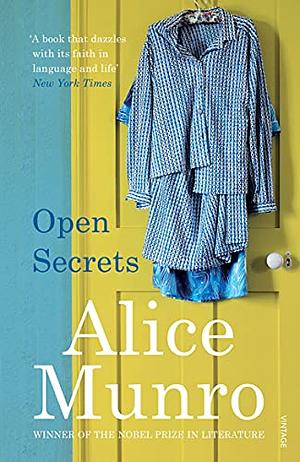
I’m initially veering a little off topic again, the topic being Canadian women’s crime fiction, to speculate about an intriguing musical genre that makes an odd appearance in Alice Munro’s story “Open Secrets.” A murder ballad is a sung story about violent death and its aftermath, including the execution of the murderer.
Some of my favourites are captured in this Rolling Stones Magazine list. “Long Black Veil” sounds like Americana, with roots perhaps in a nineteenth-century Appalachian tragedy, but was in fact penned in 1959 and first sung by Lefty Frizzell. There are notable covers by the incomparable Gillian Welch, Rosanne Cash and her somewhat-famous father, Joan Baez, and inevitably Bob Dylan. The duet that Nick Cave sings with P.J. Harvey, “Henry Lee,” is astonishing.
Back to Munro. In “Open Secrets,” a teenage girl named Heather goes missing on a CGIT (Canadian girl scouts with a United Church flavour, effectively) camping trip. She’s never seen again. The story owes a bit to the gorgeously atmospheric film Picnic at Hanging Rock, which haunted my dreams for years. And there’s a second narrative strand with the character of Maureen, who has “graduated” from being a retired lawyer’s secretary to being his wife.
Maureen’s early marital years were not great, as her husband lost interest in sex when she had an emergency hysterectomy and couldn’t give him another child. But from her current vantage point, those were the good old days. Since his stroke, the husband has acquired a penchant for violent sex accompanied by language that makes her squirm in shame, for fear they will be overheard.
A few days after Heather’s disappearance, a couple visit the husband to seek his guidance; they think they may have a clue to share with the police. What’s really interesting is Maureen’s sense of a not-fully-concealed secret, one she recalls while stirring custard and watching the skin form on its surface. Does she suspect her husband is the killer? Munro incorporates into her story a poem/song lyrics, of rather naive and crude quality, and it is essentially a murder ballad.
“And maybe some man did meet her there
That was carrying a gun or a knife
He met her there and he didn’t care
He took that young girl’s life.”
The next stanza, though, offers a more popular theory. Heather might have met up with a friend or lover, for a planned escape from the small town she’d moved to with her mother, a nurse who seems to have better things to do than parent a teenage girl.
Here’s the grisly intertext that I’m currently researching. For some period of time, Munro feared that her partner, Gerald Fremlin, was the actual murderer of Lynne Harper. Her death was famous both locally and nationally. Within days of the discovery of her body, police had settled on her teenage friend, Steven Truscott, as the likely culprit. He was found guilty, based on circumstantial evidence, and sentenced–as an adult–to hang. At age 14. It was 1959, and the law did not treat young offenders gently.
I don’t read true crime, but I did when I was a kid, and this was the first story I learned about. It’s the one that has stayed with me, because it’s almost certainly the case that Truscott wasn’t guilty. I’m personally convinced of that, in any event. The police took a blinkered view, as subsequent investigations have revealed, and didn’t follow up on all of the evidence pointing away from him. In recent years, an unnamed travelling salesman has been linked to Harper’s murder.
So why did Munro dread the possibility of learning that Fremlin had murdered Harper, who lived near his home at the time? Also, how does one sleep in a bed next to someone in these circumstances? My imagination does not extend that far. Rachel Aviv has just published a terrific article in the New Yorker, about Munro and the abuse story she refused to admit was true. A long quotation:
“Alice also said that she’d always wondered if Gerry had raped and murdered a twelve-year-old girl named Lynne Harper, who was found dead in a woodlot in Clinton, in 1959. At the time, the suggestion struck Andrea as a kind of ‘grab for air in the room.’ (Years later, Andrea began considering the idea more seriously, and she and Jenny spent a long time researching the case, which is unsolved. Andrea reported the suspicion to the police, and was interviewed, but never heard anything more. In a statement, the police said that the investigation is ongoing. Records from the case, along with conversations with people who knew Gerry or Harper at the time, suggest that his involvement was unlikely.)”
Another quotation from Aviv’s article, and this is unbearable:
“Andrea tried to talk with her father [Victoria bookseller Jim Munro] about his response to the abuse, but he seemed confused that she was still upset, and repeated the cliché that time heals all wounds. Not long afterward, he held an event at Munro’s Books for The Way the Crow Flies, a novel that dramatizes the death of Lynne Harper, the girl Alice imagined Gerry might have raped and killed. Andrea wrote me, ‘On that night, I was in agony with one of the worst migraines of my life, knowing my father partied and schmoozed, and the tragic story–mine, Lynne Harper’s–was just entertainment in his world.’”
I don’t know what to do with all of this, but my next step is re-reading Ann-Marie MacDonald’s The Way the Crow Flies. It feels very odd to revisit the Harper/Truscott case (which I haven’t thought much about since I was in junior high) four decades later.
 The Landscape of Canadian Women's Crime Fiction
Leave a comment