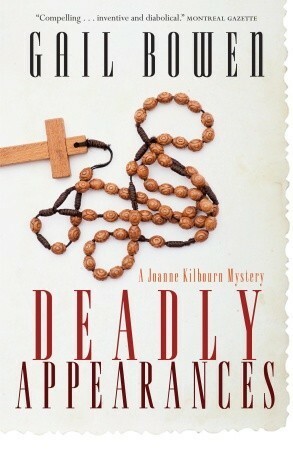
The maven of Canadian prairie mystery fiction, retired English professor Gail Bowen has published nearly twenty novels in her Joanne Kilbourn series.
When the series opens, with Deadly Appearances, Joanne is a recently widowed mother of three with years of experience in left-wing Saskatchewan politics. Her late husband was killed in an apparently random attack, and she and her children have gradually glued their lives back together.
Joanne has remained firmly in the party fold, and the novel opens with a picnic where a crowd is gathered to celebrate politician Andy Boychuk, the party leader. Joanne has written his speech, but shortly after Boychuk takes the stage he collapses. Joanne is better placed than the police to understand his tight circle of admirers and competitors, and she begins investigating his history, an inquiry that puts her in deadly peril.
As the long-running series continues, Joanne gains lovers, new friends, and an adopted daughter. But the core of the books remains her close ties to her multiple communities, in the political and academic worlds.
Some of the mysteries are set in academia, notably Burying Ariel, which pits radical feminists against the more tempered mainstream feminism espoused by Joanne herself. This is perhaps my least favourite of her books, and the politics make me a bit grumpy. The novel’s feminists, whose chief cause is violence against women, are cast as man-hating radicals intent on destroying careers over minute insults. They seize on Ariel’s stabbing to further their own cause, by portraying her as one of a series of “Riding Hoods” murdered by men. Of course (spoiler) the reality of Ariel’s life and death turns out to be much more complex.
It’s in this novel that Joanne is accused of being middle-of-the-road and middle class in her politics, and it’s a fair criticism, although she resolutely stands up for causes she believes in. Especially in the later novels, there is a somewhat self-congratulatory tone, as the now-wealthy Joanne assesses how she might improve the lives of the Indigenous working-class people in her neighbourhood.
Other novels are set in the world of media, as Joanne is drawn into work as a television political panellist by her long-time friend Jill Oziowy. One of my favourite characters for most of the series, Jill is given an oddly punitive story arc, including multiple relationships with abusive and untrustworthy men. In recent volumes, a truth about Jill’s relationship with her former boss–Joanne’s husband and the province’s youngest Attorney General–severs a longstanding friendship. And it casts Jill’s assiduous attentions to Joanne and her kids in a much more cynical light.
One of the delights of Bowen’s series is that her middle-aged heroine gets to have an interesting romantic life, and she is frank about the pleasures of sex. After several relationships that fizzle out, Joanne falls in love with and marries Zachary Shreve, a charismatic trial lawyer who’s used a wheelchair since he was hit by a drunk driver as a child. Joanne and Zachary embrace municipal politics, expanding the sphere of her investigative work, which is always prompted by family or community connections.
Several of the most interesting novels focus on Joanne’s adopted daughter, a prodigiously gifted young artist. Taylor Love is the child of Joanne’s oldest friend, also a talented artist, whose sex life fuels her work. A career-spanning exhibit of Sally Love’s oeuvre at Regina’s Mendel Gallery leads to Murder at the Mendel, in an especially distinctive novel in the series.
I would have liked to see a lot more of Sally Love’s wit and bravery, so (spoiler) it’s a bit unfortunate that she is introduced and then almost immediately disappears off stage. She does re-surface in several of Bowen’s recent novels, as Joanne begins excavating her own personal history after discovering a startling connection between herself and Sally.
But about Regina: these novels celebrate place perhaps more than any other long-running Canadian series, with the possible exception of Louise Penny’s Three Pines books. And Regina is harder to love in a number of ways than the mythical Three Pines, which doesn’t appear on any map, but makes itself mysteriously known to the people most in need of its pleasures of friendship and French food. There’s nothing remotely Brigadoon-like about Regina, a provincial capital that is often in the news in Canada for its violence and poverty, not for its small-city pleasures of established residential neighbourhoods and a robust university.
Bowen, much to her credit, brings the city to life. She makes a strong claim for paying closer attention to building mutually supportive communities, within the university, in neighbourhoods, and through networks of friends and colleagues. These are books to enjoy and re-read.
 The Landscape of Canadian Women's Crime Fiction
Leave a comment